In the context of global economic integration and Vietnam’s strong attraction for foreign direct investment (FDI), many foreign businesses choose Vietnam as a strategic destination for long-term expansion. Among the available investment structures, establishing a subsidiary is one of the most effective and flexible options. This article provides a comprehensive overview of the conditions, procedures, and benefits of setting up a subsidiary for foreign investors in Vietnam.

1. What Is a Subsidiary? Subsidiaries in Foreign Investment Activities
Definition of a Subsidiary and Its Relationship with the Parent Company
A subsidiary is a company established in one country and controlled by a foreign parent company through majority ownership of charter capital or shares. In FDI activities, the foreign parent company may own all or part of the subsidiary’s charter capital. The relationship between the two entities is reflected in the parent company’s authority to make strategic, financial, and managerial decisions for the subsidiary.
Rights and Limitations of a Subsidiary
A subsidiary is an independent legal entity in Vietnam, with its own corporate seal and bank accounts, and is legally responsible within the scope of its operations. However, its activities are still bound by decisions from the parent company, especially regarding profit remittance, investment strategies, and consolidated financial reporting. At the same time, the subsidiary must comply fully with Vietnamese laws, similar to any domestic enterprise.
The Role of Subsidiaries in FDI Strategies
Subsidiaries are a preferred investment structure for many multinational corporations when expanding into foreign markets. Compared to branches or representative offices, subsidiaries offer greater autonomy—they can directly sign contracts, conduct business operations, and participate in commercial transactions independently. Owning a subsidiary allows foreign investors to better control legal compliance, financial management, and human resources in the host country.
Why Foreign Investors Should Establish a Subsidiary in Vietnam
Vietnam presents strong market potential with stable economic growth, an improving investment environment, and a strategic location in Asia. Establishing a subsidiary not only allows investors to access local consumers but also facilitates supply chain expansion, cost optimization, and the benefits of free trade agreements. Furthermore, the subsidiary model enables foreign investors to maintain long-term control and sustainable development in the Vietnamese market.
Read more: Business Establishment in Vietnam: Subsidiary or Representative Office?
2. Conditions for Establishing a Subsidiary for Foreign Investors

Legal Basis and Applicable Regulations
The establishment of a subsidiary in Vietnam by a foreign investor is governed by the Law on Investment 2020, the Law on Enterprises 2020, and their guiding regulations. In addition, international treaties to which Vietnam is a member (such as WTO, CPTPP, EVFTA, etc.) directly affect foreign investors’ investment rights and ownership ratios in specific business sectors. Compliance with this legal framework is mandatory for a subsidiary to be licensed and operate legally in Vietnam.
Ownership Ratio and Business Lines
Foreign investors may own all or part of the charter capital of a subsidiary, depending on the registered business sector. Some sectors allow 100% foreign ownership (e.g., manufacturing, e-commerce, IT), while others—such as distribution, education, or financial services—may require joint ventures or impose ownership limits. Therefore, reviewing the intended business activities is a crucial step to assess the feasibility of the investment project.
Requirements for Financial Capacity and Experience
Not all projects require proof of financial capacity or experience; however, for large-scale or specialized sectors, licensing authorities may request audited financial statements, previous project contracts, or investment capital commitments. Clear and transparent proof of financial capability helps facilitate the review process and issuance of the Investment Registration Certificate.
Reviewing Vietnam’s International Commitments
A key factor in foreign investment is ensuring compliance with Vietnam’s market-opening commitments under the WTO and various FTAs. Certain business sectors are not fully open to foreign investors or require special conditions. Investors should carefully examine these commitment schedules and seek support from professional advisory firms to avoid errors or rejection of the application by licensing authorities.
Read more: Investment Incentives: A Comprehensive Guide for FDI Enterprises
3. Procedure for Establishing a Subsidiary for Foreign Investors
Applying for Investment Policy Approval (if required)
Not all investment projects require investment policy approval. However, projects falling under conditional investment categories—such as those involving sensitive land areas, business sectors affecting national defense and security, or large-capital projects—must obtain written approval from the Provincial People’s Committee. This is the first step for the authorities to acknowledge the investor’s intent and investment direction in Vietnam.
Applying for the Investment Registration Certificate (IRC)
For foreign direct investment (FDI) projects, investors must prepare and submit an application for an Investment Registration Certificate (IRC) to the Department of Planning and Investment in the province where the subsidiary will be located.
The application file includes:
- Investment project proposal
- Passport copy or enterprise registration certificate of the parent company
- Financial capacity documents
- Office lease agreement
- Registered business sectors
Processing time is typically 10–15 working days if the application file is valid.
Applying for the Enterprise Registration Certificate (ERC)
Once the IRC is issued, the investor proceeds to register the enterprise (ERC) to officially establish the subsidiary in Vietnam.
The application file includes:
- Company charter
- List of members or shareholders
- Legal representative information
- Charter capital
- Company seal design
After obtaining the ERC, the subsidiary becomes a Vietnamese legal entity and may conduct business activities in accordance with the law.
Completing Post-Registration Procedures
After establishment, the investor must complete several legal formalities before the subsidiary can operate, including:
- Creating and publishing the company seal
- Opening a corporate bank account
- Registering for a tax identification number
- Registering electronic invoices
- Declaring employees and enrolling in social insurance (if applicable)
Additionally, the subsidiary must apply for sector-specific business licenses if required (e.g., auditing, education, goods distribution, etc.).
Read more: Company Formation Services – Reliable & Fast at Wacontre
4. Investment Procedures for Subsidiaries with Less Than 51% Foreign Ownership
Reporting obligations under the Law on Investment 2020
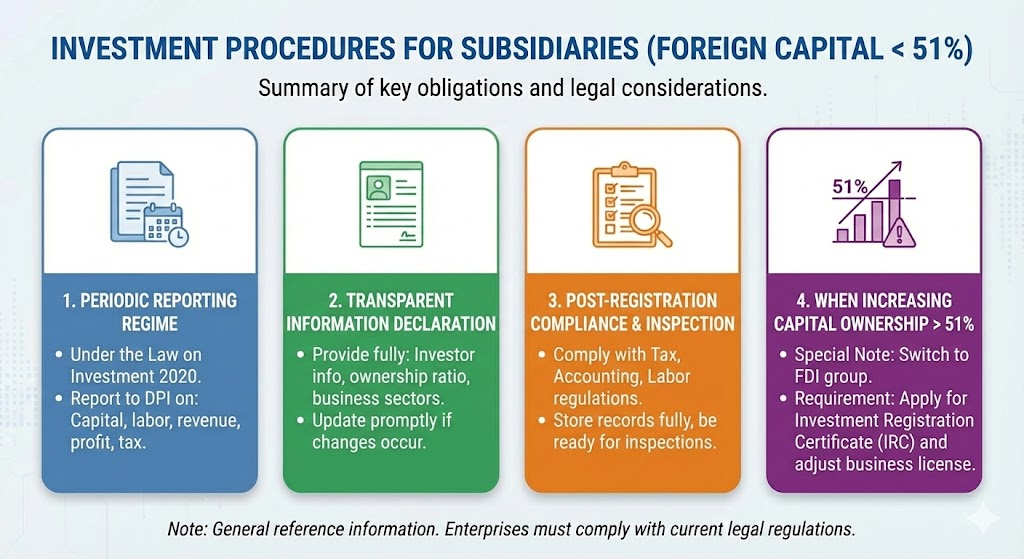
Even when foreign ownership is below 51%, a subsidiary is still considered to have foreign investment elements if the foreign investor participates in management or holds veto rights. According to the Law on Investment 2020, such enterprises must submit periodic investment activity reports to the Department of Planning and Investment where the company is registered. These reports include information on capital, labor, revenue, profit, and tax obligations.
Required reporting contents
Enterprises with less than 51% foreign ownership must report the following:
- Information on the foreign investor
- Ownership ratio
- Business sectors
- Any changes to investment registration (if applicable)
- Progress of the investment project
This information enables authorities to monitor enterprise operations and ensure compliance with Vietnam’s legal requirements and international commitments.
Legal obligations and post-registration inspections
Even without majority foreign ownership, the enterprise must fully comply with regulations on taxation, accounting, labor, and investment. Regulatory authorities have the right to conduct periodic or ad-hoc inspections to assess compliance. Therefore, the company must maintain proper records, submit timely reports, and cooperate with inspections to avoid administrative penalties.
Reclassification when foreign ownership increases
If the foreign investor increases ownership above 51%, the company will be reclassified as an FDI enterprise and must complete additional investment procedures, including:
- Applying for an Investment Registration Certificate (IRC)
- Adjusting its Business License (if applicable)
- Updating information with tax, statistical, and licensing authorities
Failure to make timely adjustments may lead to legal risks and administrative sanctions.
Establishing a subsidiary in Vietnam is a flexible and effective investment structure that allows foreign investors to maintain control and implement business strategies locally. However, the process involves multiple legal steps and strict compliance requirements. Working with a professional consultant such as Thanhlap.wacontre.com helps investors save time, ensure legal compliance, and optimize their business operations in Vietnam.
If you have any questions, please contact our Hotline at (028) 3820 1213 or email us at [email protected] for prompt consultation and support. With an experienced team, Service thanhlap.wacontre.com is always ready to serve customers in the most enthusiastic and efficient manner. (For Japanese customers, please contact Hotline: (050) 5534 5505).