In the wave of global supply chain shifts, Vietnam is becoming an ideal destination strongly attracting international investment flows. However, to realize commercial projects or build factories here, the first and most crucial “passport” that investors must possess is the approval document from state authorities. Mastering the legal regulations on licensing procedures not only helps projects launch on schedule but also avoids potential legal risks. The article below will provide you with the most comprehensive and updated overview of this procedure.
- 1. What is an Investment Registration Certificate and to Whom does it Apply?
- 2. Conditions for Issuing an Investment Registration Certificate in 2026
- 2.1. Projects not subject to approval of investment policies
- 2.2. Project objectives must not violate prohibited business sectors
- 2.3. Meeting market access conditions for foreign investors
- 2.4. Compliance with national planning and land use planning
- 2.5. Ensuring national defense, security, and environmental requirements
- 3. Core Contents Recorded on the Investment Registration Certificate
- 3.1. Investor identification information and project code
- 3.2. Project name, location, and scale of land use
- 3.3. Total investment capital and detailed capital mobilization schedule
- 3.4. Regulations on project duration and implementation schedule
- 3.5. Accompanying incentives, support, and binding conditions
- 4. Procedures and Documents for Applying for an Investment Registration Certificate
- 4.1. Step 1: Prepare the project proposal and financial capacity
- 4.2. Step 2: Submit the application file at the Department of Planning and Investment (or Management Board)
- 4.3. Step 3: State agencies appraise the validity of the application file
- 4.4. Step 4: Processing time and issuance of original certificate
- 4.5. Step 5: Execute the procedure for project implementation security deposit
- 5. The Solution: All-Inclusive Investment Registration Certificate Issuance Services
- 5.1. Legal risks when self-executing licensing procedures
- 5.2. Benefits of using Investment Registration Certificate issuance services
- 5.3. In-depth consulting with professional investment license services
- 5.4. Representing the enterprise in explaining to Ministries and Departments
- 5.5. Commitment to punctuality, transparent costs, and absolute confidentiality
1. What is an Investment Registration Certificate and to Whom does it Apply?
1.1. Legal concept of the Investment Registration Certificate
According to Clause 11, Article 3 of the Law on Investment 2020, an Investment Registration Certificate (IRC) is a paper or electronic document recording the investor’s registration information regarding an investment project. This is the highest legal basis confirming the Vietnamese State’s approval of a specific project, allowing that project to be implemented legally within the territory of Vietnam.
1.2. Cases where applying for a certificate is mandatory
Not all projects require this document. The law clearly stipulates cases where the procedure to apply for an Investment Registration Certificate is mandatory, including:
- Investment projects of foreign investors (establishing a new economic organization).
- Investment projects of economic organizations with foreign investment capital (meeting the conditions under Article 23 of the Law on Investment) when establishing another economic organization; investing by contributing capital, purchasing shares; or executing a new investment project.
1.3. Cases exempted from this procedure
Conversely, to create an open environment for domestic business, the Law stipulates cases exempted from this certificate issuance procedure, including:
- Investment projects of domestic investors (100% Vietnamese capital).
- Investment projects of economic organizations (not subject to the provisions of Clause 1, Article 23 of the Law on Investment).
- Investment in the form of M&A: Contributing capital, purchasing shares, or purchasing capital contributions of an already established economic organization.
1.4. Legal significance for foreign investment projects
For foreign investment capital flows, this document acts as the project’s “birth certificate.” Without it, investors cannot proceed to the next step of applying for an Enterprise Registration Certificate (ERC). Furthermore, this is the legal basis for investors to legally transfer investment capital from abroad into Vietnam, open a direct investment capital account, apply for land allocation, land lease, and apply for factory construction permits.
1.5. Distinguishing from the Decision on Approval of Investment Policies
Many people confuse these two concepts. The Decision on Approval of Investment Policies is the in-principle agreement of the National Assembly, the Prime Minister, or the Provincial People’s Committee for large-scale projects affecting the environment, national defense, and security, or requiring a change in land use purpose. Only after obtaining the Decision on Approval of Investment Policies can the investor proceed with the procedure to issue the Investment Registration Certificate.
2. Conditions for Issuing an Investment Registration Certificate in 2026
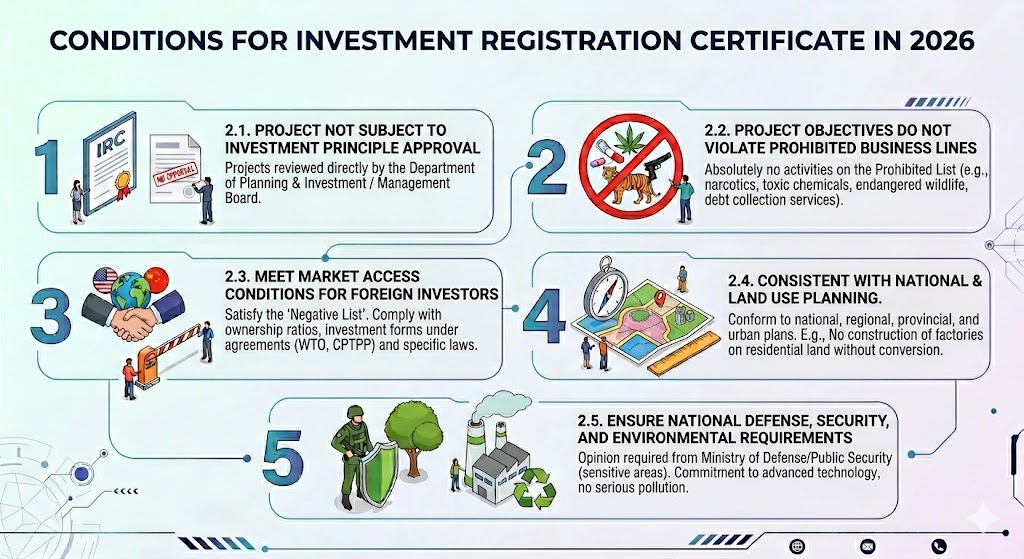
2.1. Projects not subject to approval of investment policies
To be directly reviewed and issued an Investment Registration Certificate by the Department of Planning and Investment (or the Management Board), the project must be one that does not require a Decision on Approval of Investment Policies. If the project requires the state to allocate or lease land without auction, or if it is a project to build an urban area, a golf course, etc., it is mandatory to take a detour: obtaining policy approval from the Provincial People’s Committee or the Prime Minister before applying for the certificate.
2.2. Project objectives must not violate prohibited business sectors
The prerequisite is that the operational objectives of the project must not fall under the List of business investment sectors prohibited in Vietnam (such as trading in narcotics, prohibited chemicals, endangered wild animals, prostitution business, human trafficking, trading in human body parts, and debt collection services). If any objective is violated, the entire project application file will be rejected immediately.
2.3. Meeting market access conditions for foreign investors
When foreign investment capital flows in, the project must pass the “Market Access Conditions” (Negative List) test. If the project objective belongs to a sector with conditional market access for foreign investors (e.g., logistics, education, healthcare, retail trade…), the investor must prove they fully meet conditions regarding the charter capital ownership ratio, investment form, scope of activities, and experience capacity according to Trade Agreements (WTO, CPTPP) and specialized laws.
2.4. Compliance with national planning and land use planning
The project must comply with national planning, regional planning, provincial planning, urban planning, and especially local land use planning where the project is expected to be located. For example, you cannot apply for a permit to build a chemical manufacturing plant on land designated as urban residential land or agricultural land that has not been converted in land use purpose.
2.5. Ensuring national defense, security, and environmental requirements
For projects located in border areas, islands, coastal areas, or areas sensitive to national defense and security, the licensing authority must seek appraisal opinions from the Ministry of National Defense and the Ministry of Public Security. Concurrently, the project must provide preliminary assessments of environmental impacts and commit to using advanced technology, avoiding outdated technology that poses a risk of severe environmental pollution.
3. Core Contents Recorded on the Investment Registration Certificate
3.1. Investor identification information and project code
Upon approval, each project is granted a unique 10-digit Investment Project Code, valid nationwide and unchanging throughout its operation. The Investment Registration Certificate also clearly records the Name, address, and ID card/passport/establishment license number of the individual or legal entity investor owning the project.
3.2. Project name, location, and scale of land use
The project name is displayed in Vietnamese (and may be accompanied by a foreign name). Most importantly, the project implementation location must be detailed down to the house number, street, ward/commune, district. Accompanied by the area of land used (calculated in m2 or hectares). This is the basis for the land management agency to carry out land lease procedures and calculate land rent later.
3.3. Total investment capital and detailed capital mobilization schedule
This document will lock down the figure for “Project Investment Capital,” clearly divided into two parts: Contributed capital of the investor (equity) and Mobilized capital (loans from banks, parent company…). More importantly, the Investment Registration Certificate clearly stipulates the capital contribution schedule. If the investor fails to contribute sufficient capital by the deadline specified on the certificate, they will face administrative fines, be required to explain, or even have their license revoked.
3.4. Regulations on project duration and implementation schedule
The standard operational duration of a project is 50 years (can be up to 70 years for certain disadvantaged areas). Regarding the implementation schedule, the document will clearly state the completion milestones: Schedule for completing administrative procedures, basic construction schedule, machinery and equipment installation schedule, and the schedule for officially bringing the works/project into production and business operations. Delays compared to the regulations will also lead to penalty sanctions from the Inspectorate of the Department of Planning and Investment.
3.5. Accompanying incentives, support, and binding conditions
This is the section businesses care about most. If the project is located in an incentivized area or sector, the Investment Registration Certificate will clearly state the corporate income tax incentives the project enjoys (tax exemption or reduction), import tax incentives for machinery creating fixed assets, and land rent exemption/reduction. Finally, there are specific conditions (if any) that the investor must comply with throughout the project’s operation.
4. Procedures and Documents for Applying for an Investment Registration Certificate
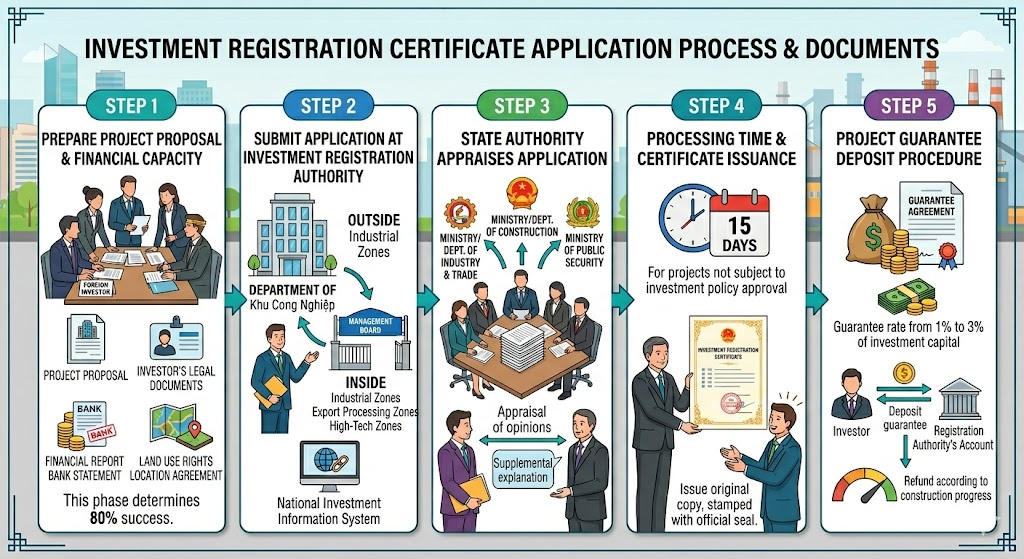
4.1. Step 1: Prepare the project proposal and financial capacity
The application file preparation stage determines 80% of the success rate. The application file includes: Written request for project implementation; Copies of the investor’s legal documents; Investment project proposal (clearly stating objectives, scale, capital, socio-economic efficiency); Copies of documents regarding land use rights or location lease agreements; Explanation of technology used (if any). Crucially, there must be Audited Financial Statements for the last 2 years or a bank balance confirmation to prove the financial capacity of the foreign investor.
4.2. Step 2: Submit the application file at the Department of Planning and Investment (or Management Board)
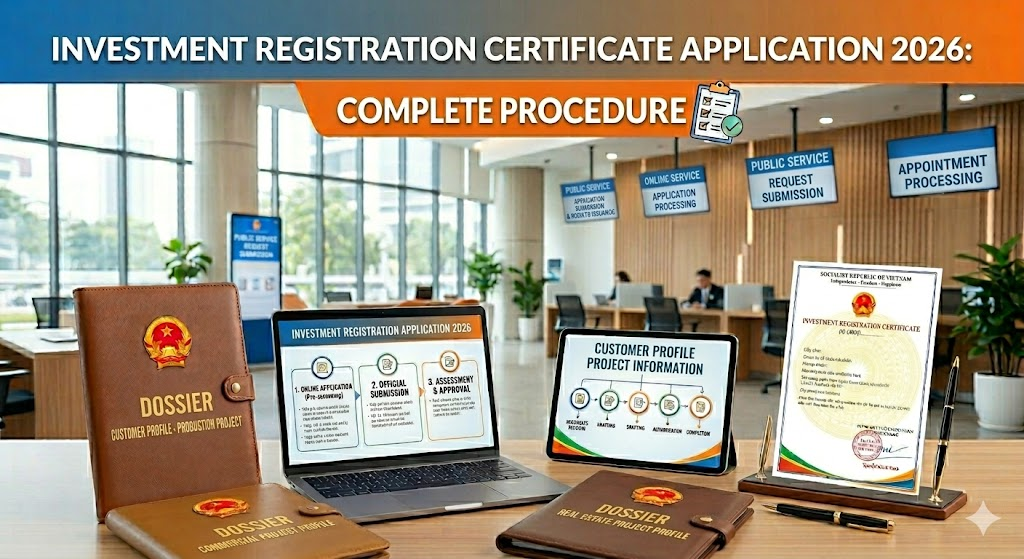
After completing 01 standard application file, the investor submits it to the competent investment registration authority. If the project is outside an industrial zone, the receiving body is the provincial/city Department of Planning and Investment. If the project is inside an Industrial Zone, Export Processing Zone, or High-Tech Zone, the application file will be submitted to the Management Board of the Industrial Zones/Economic Zones of that province. Currently, the online application submission process on the National Investment Information System has been widely applied.
4.3. Step 3: State agencies appraise the validity of the application file
Upon receiving the application file, the Investment Registration Authority will check its validity. For projects with conditional business sectors, this agency will send official dispatches to seek appraisal opinions from relevant Ministries and Departments (such as the Department of Industry and Trade, Department of Construction, Ministry of Public Security…). During this process, investors frequently have to prepare supplementary explanation letters, clarifying queries from specialized agencies to defend the project’s feasibility.
4.4. Step 4: Processing time and issuance of original certificate
According to the Law on Investment 2020, for projects not subject to approval of investment policies, the processing time to issue the Investment Registration Certificate is 15 days from the date of receiving a valid application file. When the application file passes the appraisal round, the state agency will issue a notice inviting the investor to receive the original result. This document will be embossed stamped and signed by the head of the investment registration authority.
4.5. Step 5: Execute the procedure for project implementation security deposit
Many investors think receiving the license is the end of the process. In reality, immediately after being granted the Investment Registration Certificate for projects allocated land, leased land, or permitted to change land use purposes by the State, the investor must fulfill the obligation of Escrow Deposit to secure project implementation. The deposit level is calculated as a percentage (from 1% to 3%) of the project’s investment capital. The deposit money is paid into the account of the investment registration authority and will be refunded according to the construction schedule.
5. The Solution: All-Inclusive Investment Registration Certificate Issuance Services
5.1. Legal risks when self-executing licensing procedures
Administrative procedures related to foreign investment in Vietnam are always evaluated as quite cumbersome and complex. Self-preparing application documents often runs into errors such as: Writing an “Investment project proposal” that is too sketchy to convincingly prove effectiveness; Failing to prove valid financial capacity; Mistakenly leasing land in planned areas where business is not permitted. These mistakes lead to application documents being returned multiple times, delaying the enterprise’s entire business plan and market launch.
5.2. Benefits of using Investment Registration Certificate issuance services
To eliminate all administrative barriers, utilizing a professional Investment Registration Certificate issuance service is the optimal solution. Legal experts and lawyers will handle everything from A to Z on behalf of the investor. You will not have to headache over researching laws or waiting around state agencies. The entire process of drafting application documents, notarized translation, and consular legalization of foreign documents will be handled neatly, ensuring the application file is accurate right from the first submission.
5.3. In-depth consulting with professional investment license services
A reputable investment license service provider doesn’t just “run documents.” They bring added value through strategic consulting. Before formulating the project, lawyers will advise you on how to select business industry codes to enjoy the highest preferential tax rates, advise on a reasonable capital structure to facilitate the repatriation of profits, and warn you in advance about barriers regarding sub-licenses (retail licenses, environmental licenses, fire safety) in the post-inspection stage.
5.4. Representing the enterprise in explaining to Ministries and Departments
The most difficult part of the licensing process is the explanation phase with Ministries and Departments. With extensive practical experience and good relationships with authorities, the service’s team of specialists will represent the investor in drafting sharp explanation letters, directly working with the processing officials to defend the viewpoint and feasibility of the project, helping the application file swiftly pass through tough appraisal stages.
5.5. Commitment to punctuality, transparent costs, and absolute confidentiality
Professionalism is affirmed through clear commitments. We provide all-inclusive services with transparent contracts, quoting in detail every work item (state fees, service fees, translation fees), with absolutely no hidden costs arising. We commit to delivering results exactly on the agreed deadline, helping investors master the project schedule. Concurrently, all business ideas and trade secrets of the investor are kept strictly confidential.
The Investment Registration Certificate is the very first foundation stone determining the legality and sustainability of every FDI project in Vietnam. The strictness of legal regulations demands that investors have exceedingly thorough preparation in terms of application documents and explanations. To assist enterprises in maximizing time and cost savings while minimizing legal risks, our Investment Registration Certificate issuance services are always ready to accompany you. With a dedicated team of experts deeply knowledgeable in the law, we confidently turn your investment ideas into a legal reality in the fastest and safest manner. Contact us now via Hotline (028) 3820-1213 for immediate support!
If you have any questions, please contact our Hotline at (028) 3820 1213 or email us at [email protected] for prompt consultation and support. With an experienced team, Service thanhlap.wacontre.com is always ready to serve customers in the most enthusiastic and efficient manner. (For Japanese customers, please contact Hotline: (050) 5534 5505).