Vietnam is becoming an increasingly attractive destination for FDI and foreign investment thanks to its strategic location, competitive costs, and transparent investment policies. However, choosing the right investment structure at the outset is a crucial step that determines the effectiveness and risk level throughout business operations. This article provides a comprehensive and up-to-date overview of the various types of investment in Vietnam for foreign investors.
1. What Are the Types of Investment?
Definition of Investment Under the Law on Investment
According to Vietnam’s Law on Investment 2020, investment refers to the act of an investor contributing capital through lawful methods to conduct business activities for profit. Investment may be carried out by domestic or foreign individuals or organizations and can take various forms, including establishing an economic organization, contributing capital, purchasing shares, implementing investment projects, or entering into contractual arrangements.
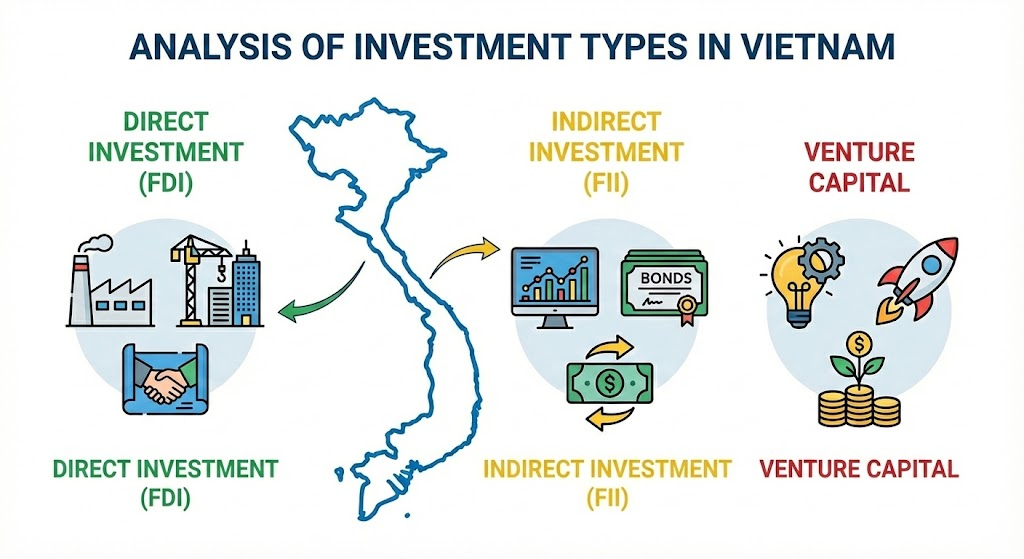
Classification of Direct and Indirect Investment
Direct investment involves the investor directly participating in the management and operation of business activities in Vietnam, such as by establishing a company or contributing capital to an existing enterprise.
Indirect investment, on the other hand, is conducted through the purchase of shares, bonds, or investment fund certificates without direct involvement in management. Each form carries its own advantages and limitations regarding the level of control, risk exposure, and legal requirements.
Domestic Investment vs. Foreign Investment
Domestic investment is conducted by investors holding Vietnamese nationality, while foreign investment (FDI) refers to investment activities undertaken by foreign individuals or organizations in Vietnam. FDI is subject to specific regulations concerning licensing procedures, ownership restrictions, permitted business sectors, and periodic reporting obligations to state authorities.
Vietnam’s Strict Legal Framework for FDI
Vietnam’s investment legal system is becoming increasingly comprehensive and aligned with international standards. However, foreign investors must carefully consider Vietnam’s commitments under WTO, CPTPP, EVFTA, and other FTAs to ensure their chosen investment structure complies with market access rules and avoids legal barriers. Working closely with professional legal advisors helps minimize risks and improve investment efficiency.
Read more: Essential Insights on Foreign Direct Investment (FDI) in Vietnam
2. Investment Type: Establishing an Economic Organization
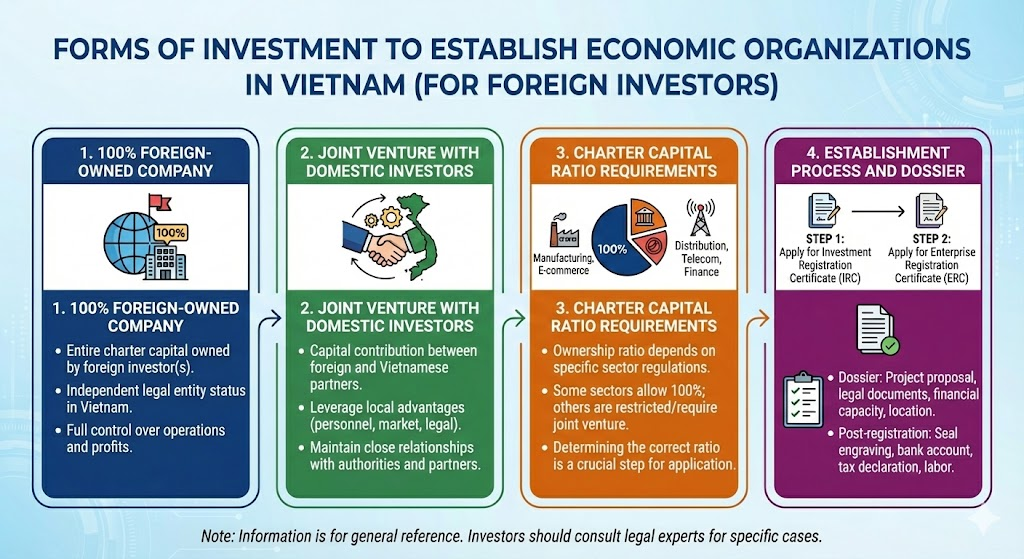
What is a 100% Foreign-Owned Company?
A 100% foreign-owned company is one of the most common forms of economic organization in foreign investment activities in Vietnam. In this model, the entire charter capital is owned by one or more foreign investors. The company is recognized as an independent legal entity in Vietnam and may operate in most business sectors that are not prohibited or restricted under international commitments.
This structure is ideal for investors who wish to maintain full control over business operations and project profits.
Joint Venture With a Domestic Investor
A joint venture is an investment model in which foreign investors contribute capital together with Vietnamese organizations or individuals to establish a new enterprise. The capital contribution ratio is agreed upon by the parties, provided it complies with the requirements of conditional business sectors.
This model offers significant advantages by leveraging local strengths such as workforce availability, market insight, legal understanding, and established relationships with local authorities and strategic partners.
Capital Ownership Requirements
Vietnam imposes different foreign ownership limits depending on the business sector. Some sectors, such as manufacturing and e-commerce, allow up to 100% foreign ownership. Others—such as distribution, transportation, telecommunications, and finance—may require a joint venture or impose ownership restrictions.
Identifying the correct ownership ratio is a crucial step to ensure that the investment registration application file complies with Vietnamese laws.
Procedures and Documentation for Establishing a Company
Establishing an economic organization in Vietnam as a foreign investor generally involves two key steps:
- Obtaining an Investment Registration Certificate (IRC)
- Obtaining an Enterprise Registration Certificate (ERC)
The required documentation includes:
- An investment proposal;
- Legal documents of the investor;
- Proof of financial capacity;
- Documents related to the project location.
After receiving both the IRC and ERC, the enterprise must complete post-licensing procedures such as engraving the corporate seal, opening a bank account, tax registration, and labor registration (if applicable).
Read more: Company Formation Services – Reliable & Fast at Wacontre
3. Investment Type: Capital Contribution and Share Acquisition
Definition and Forms of Capital Contribution
Capital contribution or share acquisition is a common form of indirect investment in which foreign investors do not need to establish a new enterprise. Instead, they acquire equity or shares in an existing Vietnamese company.
This investment method is often preferred for its flexibility, time efficiency, and ability to leverage the existing infrastructure, workforce, and customer base of the local enterprise.
Investor Rights When Contributing Capital
By acquiring shares or equity, foreign investors gain the right to receive profits from business activities and may participate in management or oversight depending on their ownership ratio.
They also have the right to transfer their equity after a certain period, receive dividends, and access transparent financial statements in accordance with Vietnamese law.
Procedures for Registering Equity or Share Acquisition
The purchase of shares in a joint-stock company or equity in a limited liability company must be registered with the Department of Planning and Investment if any of the following conditions apply:
- The foreign investor increases ownership from below 51% to above 51%;
- The target company operates in a business sector subject to foreign investment conditions;
- The acquisition results in the foreign investor gaining control over the enterprise.
The registration application file typically includes investor information, the transfer agreement, the amended charter of the company, and other documents as required.
Cases Requiring Adjustment of the Investment Registration Certificate (IRC)
If the capital contribution or share acquisition leads to changes in the content of the existing Investment Registration Certificate—such as exceeding foreign ownership thresholds, expanding or modifying business lines, or relocating the head office—the investor must carry out procedures to amend the IRC.
This ensures legal transparency for both the investor and the investee company, and provides a basis for regulatory authorities to monitor compliance with Vietnamese investment laws.
4. Project-Based Investment Types

What is a PPP Project?
A PPP (Public–Private Partnership) is a form of investment in which the public sector and private sector cooperate to implement infrastructure and public service projects. Foreign investors may participate through contractual arrangements with government authorities to jointly develop, operate, and exploit projects in areas such as transportation, healthcare, education, and environmental management. PPP projects allow for a balanced allocation of risks between the government and private investors, while encouraging private-sector participation in national infrastructure development.
Common Types of PPP Contracts
Some of the most common PPP contract models in Vietnam include:
- BOT (Build–Operate–Transfer)
- BTO (Build–Transfer–Operate)
- BT (Build–Transfer)
- BOO (Build–Own–Operate)
- BLT (Build–Lease–Transfer)
Each contract type differs in terms of ownership, operation rights, and transfer timeline, making them suitable for various project scales and sectors. Selecting the appropriate contract model helps optimize benefits for both the investor and the government.
Procedures for Implementing a PPP Project
To participate in a PPP project, investors must follow several steps, including:
- Registering the project;
- Submitting an investment proposal;
- Participating in bidding or being appointed (depending on the project);
- Negotiating and signing the PPP contract;
- Implementing and operating the project.
The application application file typically includes: the project proposal, documents demonstrating financial and technical capacity, an implementation plan, and a capital recovery plan.
PPP projects must comply with the Law on Public–Private Partnership (Law on PPP) and its implementing regulations.
Reviewing FDI Commitments in PPP Projects
Since PPP projects often involve sensitive sectors such as infrastructure, healthcare, and education, foreign investors must carefully review Vietnam’s FDI commitments under WTO, CPTPP, EVFTA, and other FTAs.
Some sectors still impose foreign ownership limits or require joint ventures with Vietnamese partners. Additionally, investors should evaluate issues such as:
- national security considerations,
- long-term land use rights,
- revenue and profit repatriation mechanisms.
A thorough assessment helps ensure compliance and reduces legal risks when participating in PPP projects.
5. Investment Form Under a BCC Contract
What is a BCC?
A Business Cooperation Contract (BCC) is an investment form in which two or more parties—whether foreign investors, domestic investors, or both—enter into a contract to jointly conduct business activities and share profits without establishing a new legal entity.
Recognized under the Law on Investment 2020, a BCC is suitable for short-term projects or cases where investors wish to minimize administrative procedures while still participating in business activities in Vietnam.
When Should Investors Choose a BCC?
A BCC is commonly chosen when foreign investors want to quickly enter the Vietnamese market without setting up a subsidiary or joint venture.
This form is particularly advantageous in sectors with specific regulatory requirements such as:
- Telecommunications
- Oil and gas
- Construction
- Infrastructure
In these industries, establishing a new legal entity may be unnecessary, restricted, or subject to complicated licensing conditions.
BCCs are also ideal for pilot projects or phased cooperation where flexibility is required.
Key Components of a BCC Contract
A valid BCC must clearly outline the following:
- Information of all participating parties
- Objectives and scope of cooperation
- Term of the contract
- Profit- and cost-sharing arrangements
- Rights and obligations of each party
- Joint management mechanisms
- Dispute resolution procedures
- Conditions for termination
This contract serves as the legal basis for project implementation and provides the framework for resolving issues during the cooperation process.
Rights and Obligations of the Parties in a BCC
Each party in a BCC remains legally responsible on an individual basis for the obligations it undertakes.
At the same time, they are entitled to:
- Receive profits according to the agreed ratio
- Use their assets, technology, or trademarks within the scope of the cooperation
- Participate in joint management activities
However, because a BCC does not create a separate legal entity, effective communication, transparency, and coordination between the parties are essential to avoid disputes and ensure successful business performance.
Read more: BCC Contracts in Foreign Investment: Latest Regulations
Choosing the right investment structure not only helps businesses optimize costs and legal procedures but also ensures operational efficiency and long-term value. Thanhlap.wacontre.com supports investors in accurately assessing risks, selecting the optimal investment model, and completing all investment documentation quickly and comprehensively.
If you have any questions, please contact our Hotline at (028) 3820 1213 or email us at [email protected] for prompt consultation and support. With an experienced team, Service thanhlap.wacontre.com is always ready to serve customers in the most enthusiastic and efficient manner. (For Japanese customers, please contact Hotline: (050) 5534 5505).