A Food Safety Certificate is a mandatory requirement for food production companies to ensure food hygiene and safety for consumers. Not only does this certificate help businesses comply with the law, but it also builds credibility and enhances product quality in the market. However, not everyone is fully aware of the conditions, procedures for obtaining the certificate, and the penalties for violations. The article below will help you understand all the important information related to the Food Safety Certificate.
1. What is a Food Safety Certificate?
1.1. Definition of a Food Safety Certificate
A Food Safety Certificate is a legal document issued by the competent government authority, confirming that a food production or business establishment meets all food hygiene and safety requirements according to legal regulations. This certificate is a mandatory condition for food production companies to operate legally.
The certificate not only ensures that food products are produced in a safe environment, free from health risks to consumers, but also helps enhance product quality and brand reputation in the market. Additionally, it helps businesses avoid legal risks and penalties or suspension of operations due to violations of food safety regulations.
1.2. Who needs to apply for a Food Safety Certificate?
The Food Safety Certificate applies to all food production and business establishments, including but not limited to:
- Food production companies: Facilities involved in food processing, manufacturing packaged food, ready-to-eat foods, dietary supplements, beverages, etc.
- Restaurants, eateries, and canteens: Food service businesses must obtain this certificate to ensure the safety of food for customers.
- Supermarkets and food stores: Businesses selling food, fresh products, and frozen goods also need this certificate to legalize their operations.
- Industrial meal suppliers: Providers of meals for schools, companies, hospitals, etc., must have the certificate to ensure food hygiene standards.

1.3. Benefits of Having a Food Safety Certificate
Having a Food Safety Certificate brings many important benefits. First, businesses will comply with legal regulations, avoiding penalties or suspension of operations. Second, the certificate helps build trust with customers and partners, enhancing the brand reputation. Additionally, having the certificate makes it easier for businesses to expand their market and distribute products in supermarkets and large distribution networks. More importantly, ensuring food hygiene and safety protects consumers’ health and contributes to improving the quality of food in the market.
1.4. Exemptions from the Food Safety Certificate
Some food production and business establishments are not required to apply for a Food Safety Certificate. Specifically, small-scale household food producers who do not sell on a wide market may be exempt. Stores selling pre-packaged food that does not undergo further processing also do not need to apply for the certificate. Furthermore, businesses producing food for export based on the standards of the importing country may be exempt if they do not distribute their products domestically. However, even though these establishments are exempt from the certificate, they must still comply with general food hygiene and safety standards as required by law.
The Food Safety Certificate is not only an important legal condition but also a factor that helps businesses grow sustainably, enhance brand reputation, and ensure public health.
2. Conditions for Issuing a Food Safety Certificate for Food Production Companies

2.1. Legal Conditions for Applying for a Food Safety Certificate
To obtain a Food Safety Certificate, the food production company must have a business registration license with activities related to food production and processing. If the company has not yet registered the appropriate business activities, it must make adjustments before applying for the certificate. Additionally, the company must comply with the current legal regulations on food safety, environmental protection, and labor hygiene. Meeting these legal conditions helps the business avoid violations and ensures the legality of its production and business activities.
2.2. Requirements for Infrastructure and Equipment
The food production company must have appropriate facilities for production activities, including workshops, storage for raw materials, and finished products that meet hygiene standards. The equipment and machinery used in the food processing and packaging process must be clean, safe, and prevent cross-contamination. Additionally, the company must have a waste and wastewater treatment system that complies with regulations to minimize environmental impact. Meeting these requirements ensures that the products are of good quality and safe for consumers.
2.3. Food Safety Standards in Production
To obtain the certificate, the food production company must adhere to strict hygiene standards. The water used in food processing must be clean and meet technical standards. The production process must be organized in a way that prevents cross-contamination between raw materials, finished products, and waste. The food storage system must maintain appropriate temperature and humidity conditions to prevent spoilage. Moreover, the company must establish a quality control process to ensure that the products always meet food safety standards.
2.4. Personnel and Relevant Certifications Requirements
Personnel involved in food production must meet health and food safety knowledge requirements. Each employee needs to have a health check certificate confirming their eligibility to work in the food industry. Additionally, the company must organize or assign employees to attend food safety and hygiene training courses and obtain valid certificates. Ensuring the right personnel conditions helps the business improve production quality and reduce the risk of food safety issues.
2.5. Validity Period and Renewal Requirements for the Food Safety Certificate
The Food Safety Certificate is valid for 3 years from the issuance date. Before the certificate expires, the business must apply for renewal to continue legal operations. The renewal application includes a request form, the old certificate, and documents proving that the business still meets all food safety conditions. If the certificate is not renewed in time, the business may face fines and suspension of food production activities. Proactively renewing the certificate helps the business maintain stable operations and avoid unnecessary legal risks.
Learn more: Establishing a 100% Foreign-Owned Company in the Food Manufacturing Industry
3. Procedures for Applying for the Food Safety Certificate
3.1. Documents Required for Applying for a Food Safety Certificate
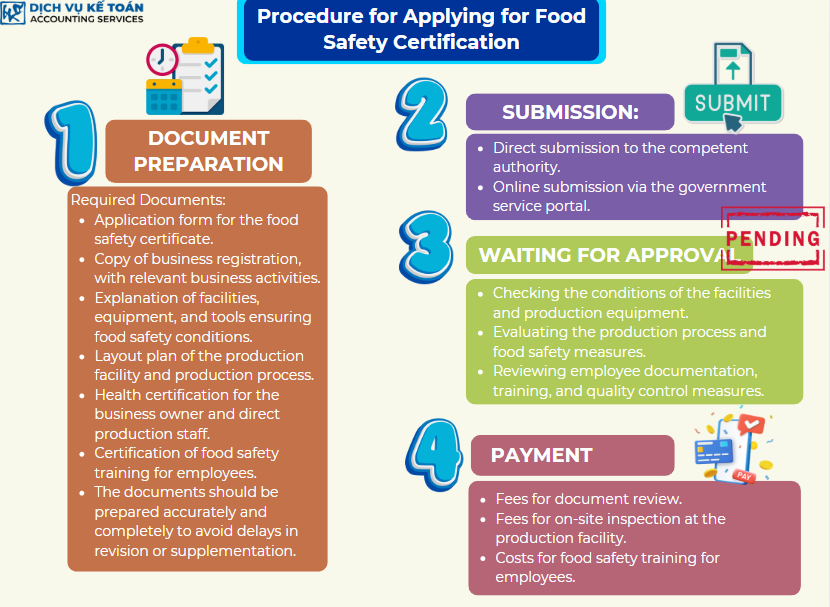
To apply for a Food Safety Certificate, the food production company needs to prepare a complete set of documents as required. The documents include:
- Application form for the Food Safety Certificate (according to the prescribed template).
- A copy of the business registration certificate, including relevant business activities related to food production.
- A description of the facilities, equipment, and tools that ensure food safety conditions.
- A floor plan of the production facility and the food production process.
- Health certificates for the facility owner and staff directly involved in food production.
- A certificate confirming that workers have been trained in food safety knowledge.
The documents must be prepared accurately and fully to avoid delays in corrections or additions.
3.2. Submission Process and Receiving Authority
After preparing all the required documents, the business submits them to the Food Safety and Hygiene Sub-Department under the Department of Health in the province/city where the company is based. Some specific industries may submit their documents to the Food Safety Department of the Ministry of Health or the Department of Agriculture and Rural Development.
The submission process can be done in two ways:
- Submit directly to the competent government authority.
- Submit the documents online through the public service system if available.
Once the documents are received, the relevant authorities will check for validity and notify the applicant if additional information is needed.
3.3. Time for Review and Issuance of the Food Safety Certificate
Once the valid documents are received, the authorities will send a team to inspect the food production facility. The inspection process includes:
- Checking the condition of the facility and production equipment.
- Evaluating the production process and measures taken to ensure food safety.
- Reviewing documents related to personnel, training, and quality control.
If the facility meets the requirements, the Food Safety Certificate will be issued within 15 working days. If the facility does not meet the requirements, the business will need to address the issues and resubmit the application.
3.4. Costs for Applying for a Food Safety Certificate
The cost of applying for a Food Safety Certificate is not fixed and depends on the size of the business and the local area. Typically, the cost ranges from 3,000,000 to 10,000,000 VND, which includes:
- Fee for document verification.
- Fee for the on-site inspection at the production facility.
- Training costs for food safety knowledge for employees (if needed).
In addition to the government fees, if the business uses consultancy services to assist with the documentation and procedures, there may be additional service fees. Preparing the documents correctly from the beginning helps the business save time and costs during the certification process.
4. What is the penalty for not having a Food Safety Certificate?
4.1. Penalty According to the Latest Regulations
According to Decree 115/2018/ND-CP, food production companies without a Food Safety Certificate will face administrative fines ranging from 30,000,000 to 40,000,000 VND. This fine applies to food production and processing establishments that operate without a valid certificate, except for those exempt from the requirement.
In addition to the fine, the company may face further penalties such as suspension of operations, product recall, or being forced to destroy goods that do not meet food safety standards. Not having the certificate not only impacts the company’s reputation but also poses a significant risk if there is a sudden inspection by authorities.
4.2. Penalty Measures for Food Production Companies Violating Regulations
If a company violates food safety regulations, in addition to the monetary fine, the authorities may impose several other penalties, such as:
- Forced suspension of production or business activities for 3 to 6 months for serious violations.
- Recall of all non-compliant products that do not meet food safety standards.
- Forcing the company to alter the intended use or destroy products if they pose a health risk to consumers.
- Publicly announcing the violation in the media to warn consumers.
Companies need to be diligent in fully complying with food safety regulations to avoid negative consequences that could affect their business operations.
4.3. Responsibilities of Businesses in Compliance with Food Safety Regulations
To avoid violations and penalties, businesses should proactively take the following measures:
- Apply for a Food Safety Certificate as soon as production activities begin to ensure legal operation.
- Maintain proper food safety conditions, from facilities and equipment to production and food storage processes.
- Regularly inspect the quality of raw materials and finished products to ensure compliance with food safety standards.
- Organize periodic training for staff on food hygiene and safety to minimize risks during production.
- Renew the Food Safety Certificate on time to prevent business interruptions and avoid unnecessary penalties.
Complying with food safety regulations not only helps the business avoid fines but also enhances brand reputation, builds trust with customers, and strengthens partnerships with business partners.
A Food Safety Certificate is a crucial requirement for food production businesses. It not only ensures legal compliance but also guarantees food hygiene and enhances brand credibility. Understanding the conditions, procedures for obtaining the certificate, and penalties for violations will help businesses operate legally and avoid legal risks. If assistance is needed, you can contact professional consultancy services to make the certification process quicker and smoother.
If you have any questions, please contact our Hotline at (028) 3820 1213 or email us at [email protected] for prompt consultation and support. With an experienced team, Service thanhlap.wacontre.com is always ready to serve customers in the most enthusiastic and efficient manner. (For Japanese customers, please contact Hotline: (050) 5534 5505).