Vietnam continues to be an attractive destination for foreign direct investment (FDI), leading to a rapid increase in demand for establishing 100% foreign-owned companies. However, the legal framework is frequently updated, and market access conditions vary by industry.
This article helps you understand what a 100% foreign-owned company is, the establishment procedures and required documentation, as well as important legal considerations under the latest regulations, enabling foreign investors to plan their investments in Vietnam effectively while ensuring full legal compliance.
- 1. What Is a 100% Foreign-Owned Company?
- 2. Procedures for Establishing a 100% Foreign-Owned Company
- 3. Documents Required for Establishing a 100% Foreign-Owned Company
- 4. Key Notes for 100% Foreign-Owned Companies Under the Latest Regulations
- 4.1. “Special Procedures” to Shorten Timelines for Priority Projects
- 4.2. New Application Forms and Reporting Templates (Mandatory from 15 February 2024)
- 4.3. Market Access Restrictions (Negative List)
- 4.4. Project Amendments, IRC Adjustments, and M&A Transactions
- 4.5. Ongoing Reporting and Operational Compliance Obligations
- 5. Tax, Accounting, and Corporate Governance of a 100% Foreign-Owned Company
1. What Is a 100% Foreign-Owned Company?
1.1. Legally Standard Definition
A 100% foreign-owned company (fully owned by foreign investors) is an enterprise established in Vietnam and operating in accordance with the Law on Investment 2020 and its implementing regulations. The foreign investor owns the entire charter capital, independently determines business strategies, governance structure, and bears full responsibility for business performance.
The core legal framework governing this model includes the Law on Investment 2020 and Decree No. 31/2021/ND-CP, which provides detailed guidance, including the List of industries and sectors with restricted market access for foreign investors.
1.2. Legal Forms and Ownership Structure
Foreign investors may choose among several legal forms, such as a limited liability company (single-member or multi-member), a joint-stock company, or a partnership. The choice of legal form should be carefully considered based on factors such as the scale of FDI capital, future fundraising plans, transferability of capital, and corporate governance requirements. Joint-stock companies are generally more suitable for capital mobilization and listing, while limited liability companies offer more streamlined decision-making mechanisms. Regardless of the chosen form, the enterprise remains subject to Vietnamese law and applicable international treaties to which Vietnam is a party.
1.3. Fundamental Rights and Obligations
Foreign investors have the right to manage the enterprise, distribute profits, and legally remit profits abroad. Correspondingly, they are obliged to comply with tax declarations and payments, accounting standards, periodic investment reporting, and specific conditions applicable to conditional business sectors. In the event of changes in project scale, objectives, or capital transfers, the enterprise must carry out investment adjustment procedures in accordance with the Law on Investment and Decree No. 31/2021/ND-CP, including the application of conditions applicable to “foreign investors” in cases specified under Article 23 of the Law on Investment.
1.4. Advantages and Disadvantages Compared with Joint Ventures
Advantages include full operational control, unified governance standards across the group, autonomy over technology and capital, and long-term strategic sustainability.
Disadvantages include the obligation to independently satisfy all legal requirements, higher compliance risks in sectors subject to market access restrictions, and the possible need to obtain additional sub-licenses for certain activities such as retail trading or e-commerce.
Industries and sectors subject to restricted or prohibited market access are specified in Appendix I of Decree No. 31/2021/ND-CP.
2. Procedures for Establishing a 100% Foreign-Owned Company
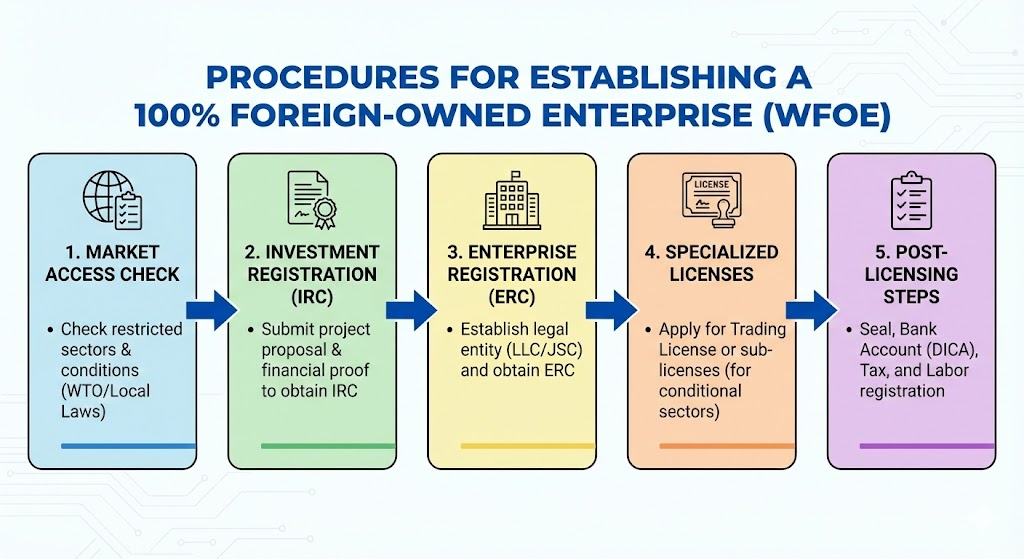
2.1. Review of Business Lines and Market Access Conditions
The first step is to determine whether the intended business lines fall under the List of restricted or prohibited market access sectors for foreign investors. If the business is subject to restrictions, the investor must satisfy applicable conditions such as ownership caps, scope of activities, local partner requirements, or specific legal forms. At the same time, it is essential to review sector-specific regulations (e.g. logistics, education, healthcare, fintech, etc.) to anticipate any sub-licenses required after enterprise registration. The legal basis for this review includes Decree No. 31/2021/ND-CP and relevant international treaties applicable to Vietnam.
2.2. Application for the Investment Registration Certificate (IRC)
Most FDI projects are required to obtain an Investment Registration Certificate (IRC) before proceeding with enterprise registration. The application application file typically includes:
- Investment project proposal;
- Documents proving the investor’s financial capacity;
- Legal documents of the investor;
- Project location documents;
- Proposed investment capital and scale.
The investment registration authority assesses the project’s objectives, scale, business lines, and compliance with planning regulations. For projects eligible for special mechanisms (see Section 4.1), accelerated procedures may apply under Decree No. 19/2025.
2.3. Application for the Enterprise Registration Certificate (ERC)
Upon issuance of the IRC, the investor submits an application to the Department of Planning and Investment to obtain the Enterprise Registration Certificate (ERC), which formally establishes the legal entity. Depending on the chosen legal form (limited liability company or joint-stock company), the application file includes the company charter, list of members or shareholders, and information on the legal representative. Special attention should be given to ensuring a lawful registered address, correct business lines under Vietnam’s standard industrial classification system, and compliance with statutory capital requirements (if applicable).
2.4. Business License / Sub-Licenses (If Applicable)
If the company engages in the trading of goods or activities directly related to goods trading, it may be required to obtain a Business License and/or a Retail Outlet Establishment License, in accordance with commercial laws and sector-specific regulations. These sub-licenses are generally applied for after the ERC is issued, but should be anticipated from the outset to minimize delays and shorten the time to operational launch.
2.5. Post-Registration Procedures
After establishment, the company must complete several post-registration tasks, including:
- Company seal engraving;
- Opening a Direct Investment Capital Account (DICA) or other applicable capital accounts;
- Tax registration and submission of initial tax declarations;
- Registration and notification of electronic invoice usage;
- Labor registration and social insurance enrollment;
- Periodic investment reporting in accordance with updated reporting templates (see Section 4.2).
3. Documents Required for Establishing a 100% Foreign-Owned Company
3.1. Individual Investors
An individual foreign investor must prepare the following documents:
- A valid passport (notarized and consular legalized if issued overseas);
- Documents proving financial capacity (bank balance confirmation or statements);
- Investment project proposal;
- Office/land lease agreement (if available);
- Evidence of the lawful source of contributed capital.
All documents must be translated into Vietnamese and notarized as required by the investment registration authority. The investment project proposal should clearly present the project objectives, FDI capital scale, labor demand, and expected socio-economic efficiency.
3.2. Institutional (Corporate) Investors
For institutional investors, the required documents typically include:
- Business registration certificate or certificate of incorporation;
- Company charter or equivalent constitutional documents;
- Most recent audited financial statements;
- Board resolution and/or power of attorney appointing the capital representative;
- Passport of the proposed legal representative of the Vietnam-based company.
For conditional business sectors, the investor may also be required to demonstrate relevant experience, technical capacity, safety standards, cybersecurity compliance, or professional licenses, in accordance with specialized laws.
3.3. Consular Legalization and Translation Standards
Documents issued overseas must be consular legalized and notarizedly translated into Vietnamese, unless exempted under an applicable international treaty. Proper standardization of documents from the outset helps minimize requests for amendments or supplements and significantly shortens the processing time for the IRC and ERC.
3.4. Key Contents of the Investment Project Application file
The project explanation must clearly describe:
- Applied technology (if any);
- Land use or factory/office requirements;
- Environmental protection plans;
- Fire prevention and safety measures;
- Impact assessments (if applicable);
- Capital contribution schedule and recruitment roadmap.
For projects located in high-tech parks or industrial zones, additional documents proving compliance with high-tech criteria or infrastructure requirements of the zone may be required.
3.5. Updated Application Forms Under New Regulations
From 15 February 2024, several application forms and investment reporting templates have been amended or replaced under Circular No. 25/2023/TT-BKHĐT, which revises Circular No. 03/2021/TT-BKHĐT. Enterprises must ensure the use of updated forms when submitting applications for IRC issuance, project amendments, or periodic investment reports to avoid procedural delays.
4. Key Notes for 100% Foreign-Owned Companies Under the Latest Regulations
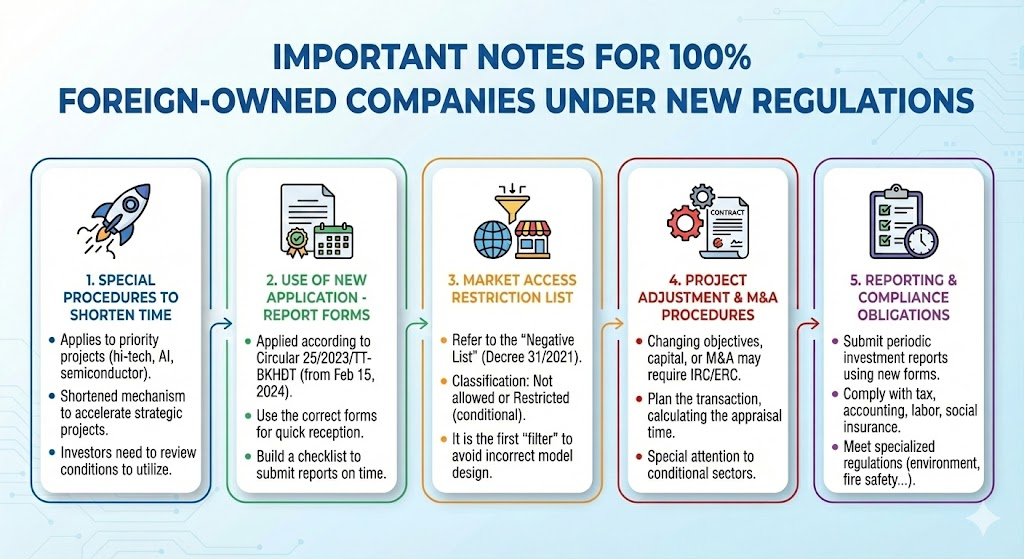
4.1. “Special Procedures” to Shorten Timelines for Priority Projects
From 15 January 2025, Law No. 57/2024/QH15 amending the Law on Investment 2020 took effect, followed by Decree No. 19/2025/NĐ-CP, which introduces special investment procedures for certain priority projects (e.g., high-tech, semiconductors, AI, advanced manufacturing). This mechanism provides a streamlined and fast-tracked process for the issuance or amendment of the Investment Registration Certificate (IRC), with separate processing tracks designed to accelerate strategic projects, subject to sector-specific conditions and eligibility criteria. Investors should carefully assess whether their projects qualify in order to take full advantage of this mechanism.
4.2. New Application Forms and Reporting Templates (Mandatory from 15 February 2024)
Circular No. 25/2023/TT-BKHĐT revises the application forms and periodic investment reporting templates (monthly, quarterly, and annual). Using the correct and updated forms is essential to ensure prompt application file acceptance and to minimize requests for amendments or supplementation. FDI enterprises should establish an internal reporting calendar and compliance checklist to ensure timely submission of investment reports in accordance with the new templates.
4.3. Market Access Restrictions (Negative List)
When defining business scope, investors must always cross-check Appendix I of Decree No. 31/2021/NĐ-CP:
- Prohibited sectors: market access is entirely denied;
- Restricted sectors: market access is permitted only upon satisfaction of specific conditions (e.g., ownership caps, legal form, operational scope).
This negative list serves as a primary compliance filter to avoid designing an investment structure that could delay or block licensing.
4.4. Project Amendments, IRC Adjustments, and M&A Transactions
Changes to project objectives, capital scale, location, duration, or M&A transactions resulting in foreign investors obtaining control may trigger procedures for amending the IRC/ERC and/or obtaining approval for capital contribution or share acquisition under the Law on Investment. Transaction planning should factor in appraisal timelines related to market access conditions, competition law, and national security, particularly in conditional sectors.
4.5. Ongoing Reporting and Operational Compliance Obligations
FDI enterprises must comply with:
- Periodic investment reporting under the updated templates;
- Tax, accounting, and e-invoicing obligations;
- Labor and social insurance requirements;
- Sector-specific regulations (environmental protection, fire prevention and fighting, information security, etc.).
For trading, distribution, or retail activities, enterprises must closely monitor requirements for Business Licenses and conditions applicable to retail outlets.
5. Tax, Accounting, and Corporate Governance of a 100% Foreign-Owned Company
5.1. Corporate Income Tax (CIT), VAT, and Investment Incentives
Enterprises are subject to Corporate Income Tax (CIT) at the prevailing statutory rates. Projects implemented in incentivized sectors or geographical areas may be entitled to tax incentives, such as CIT exemption or reduction for a prescribed period. Value-Added Tax (VAT) applies depending on the specific categories of goods and services. When planning foreign investment projects, investors should assess investment incentives in parallel (tax incentives, land rental incentives, etc.) and strictly comply with project timelines to avoid the risk of incentive revocation.
5.2. Personal Income Tax (PIT) and Foreign Employees
Foreign employees must obtain a work permit (or qualify for a work permit exemption where applicable) and register for Personal Income Tax (PIT). Enterprises are responsible for PIT withholding, declaration, and finalization in a timely manner, and should design net/gross-up compensation policies to optimize employment costs. Labor contracts, internal labor regulations, and collective bargaining agreements should be carefully reviewed. Special attention should be paid to regulations on overtime, leave entitlements, and mandatory social insurance for foreign employees, where applicable.
5.3. Accounting, Audit, and Related-Party Transactions
Enterprises must apply Vietnamese Accounting Standards (VAS), issue electronic invoices, and prepare annual financial statements (which may be subject to independent audit, depending on scale and sector). For multinational groups, transfer pricing compliance is critical. Enterprises must prepare related-party transaction documentation (Local File, Master File, and CbCR where required) and establish transparent internal pricing policies to mitigate tax inspection and audit risks.
5.4. Corporate Governance and Internal Compliance
Enterprises should establish robust governance frameworks, including the company charter, authorization and delegation rules, signing authority, investment decision-making procedures, and systems for managing legal, tax, and labor risks.
It is recommended to build a “compliance calendar”, covering deadlines for sub-licenses, capital contribution schedules, investment reporting, tax finalization, audits, and financial statement submissions, in order to avoid administrative penalties.
5.5. Estimated Costs and Implementation Timeline
Actual timelines depend on the business sector, project location, and the level of application file preparation. A standard process typically includes: market access review → IRC application → ERC application → post-licensing procedures and sub-licenses. Projects eligible for special investment procedures (e.g., high-tech projects) may benefit from a shortened timeline under Decree No. 19/2025/NĐ-CP, provided all criteria are met. Thorough application file preparation from the outset can significantly reduce opportunity costs and implementation delays.
Establishing a 100% foreign-owned company in Vietnam is an optimal choice for investors seeking full managerial control, unified governance standards, and a long-term FDI strategy. To proceed efficiently, lawfully, and comprehensively, investors should begin by reviewing the market access list (Decree No. 31/2021/NĐ-CP), applying the updated forms (Circular No. 25/2023/TT-BKHĐT), and considering eligibility for special procedures under Decree No. 19/2025/NĐ-CP. Careful application file preparation, proactive compliance management, and early planning for sub-licenses will help ensure smooth operations and sustainable business development in Vietnam.
If you have any questions, please contact our Hotline at (028) 3820 1213 or email us at [email protected] for prompt consultation and support. With an experienced team, Service thanhlap.wacontre.com is always ready to serve customers in the most enthusiastic and efficient manner. (For Japanese customers, please contact Hotline: (050) 5534 5505).