
Vietnam is rising strongly as a bright spot on the global economic map, becoming an ideal “landing zone” for international capital flows thanks to political stability and open-door policies. However, every playground has its own rules. When foreign investors want to enter the market, establishing a company is not merely about submitting documents; it is a process of proving comprehensive capacity. So specifically, to be granted a legal business license, what legal and technical barriers must investors meet? The article below will provide an in-depth analysis of the conditions for establishing an FDI company, helping you step firmly on your investment path in Vietnam.
- 1. What are the conditions for establishing an FDI company? Legal Overview
- 1.1. Concept of FDI Company and establishing a foreign-invested enterprise
- 1.2. Why do investors need to understand the conditions before injecting capital?
- 1.3. Legal basis: Law on Investment and WTO commitments
- 1.4. Common forms of foreign investment in Vietnam
- 1.5. Subjects entitled to establish FDI companies
- 2. Details of the 5 Most Important Conditions for Establishing an FDI Company
- 2.1. Conditions regarding nationality and legal status of the investor
- 2.2. Strict regulations on financial capacity and charter capital
- 2.3. Requirements for company headquarters and project location
- 2.4. Conditions regarding foreign ownership ratio
- 2.5. Conditions regarding experience capacity in specific fields
- 3. Process of Meeting Conditions for Establishing an FDI Company in Reality
- 3.1. Preparing legal application documents and economic-technical explanation
- 3.2. Applying for the Investment Registration Certificate (IRC)
- 3.3. Carrying out procedures for the Enterprise Registration Certificate (ERC)
- 3.4. Seal engraving and registering investment capital bank account
- 3.5. Completing tax obligations and sub-licenses (if any)
- 4. Barriers When Reviewing Conditions for Establishing an FDI Company
- 4.1. List of business lines with restricted market access
- 4.2. Projects affecting national defense, security, and culture
- 4.3. Risks when leasing locations without clear legal documents
- 4.4. Difficulties in proving the source of investment cash flow
- 4.5. Benefits of using professional consulting services
1. What are the conditions for establishing an FDI company? Legal Overview
1.1. Concept of FDI Company and establishing a foreign-invested enterprise
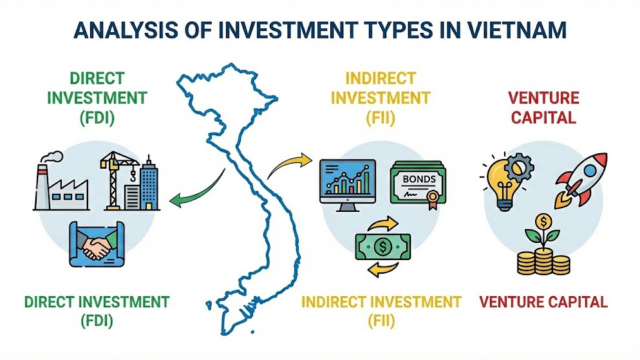
FDI (Foreign Direct Investment) is a form of long-term direct investment from abroad. Accordingly, establishing an FDI company is understood as a foreign investor providing capital to establish a new economic organization in Vietnam, or contributing capital/purchasing shares to participate in the management of an enterprise. Unlike indirect investment forms aimed solely at enjoying dividends, establishing a foreign-invested enterprise requires investors to participate directly in the operation process, be responsible for business results, and strictly comply with the legal system of the host country. This is the first and most important step to having an official commercial presence.
1.2. Why do investors need to understand the conditions before injecting capital?
Although the Vietnamese market is open, there is still a complex system of “investment conditions” aimed at protecting economic security and domestic enterprises. Failure to understand the conditions for establishing an FDI company from the beginning can lead to fatal risks such as: the project being refused licensing, capital being stuck in banks unable to be disbursed, or violating regulations on prohibited investment sectors. Understanding the “rules of the game” helps investors accurately estimate costs and time-to-market, while building the most suitable capital structure and governance model, avoiding wasting resources on unnecessary administrative procedures.
1.3. Legal basis: Law on Investment and WTO commitments
All activities related to establishing a company with foreign elements are currently directly governed by the Law on Investment 2020, the Law on Enterprises 2020, and guiding Decrees (such as Decree 31/2021/ND-CP). Besides domestic laws, Vietnam is a member of the WTO and many free trade agreements (FTAs) such as EVFTA and CPTPP. Therefore, the conditions for establishing an FDI company are also governed by Vietnam’s Schedule of Specific Commitments in Services. For example, some industries like advertising, logistics, or retail distribution have separate market opening roadmaps; if not researched carefully, investors can easily encounter legal obstacles.
1.4. Common forms of foreign investment in Vietnam
Currently, Vietnamese law is quite flexible regarding investment forms to attract resources. Common forms of establishing foreign-invested enterprises include:
- Investment to establish a new economic organization: Can be a 100% foreign-owned company or a joint venture between foreign investors and Vietnamese partners.
- Investment by contributing capital, purchasing shares, or purchasing capital contributions: This is an M&A (Mergers and Acquisitions) form, helping investors leverage the existing facilities and market share of Vietnamese enterprises.
- Investment under BCC contracts (Business Cooperation Contracts) or PPP (Public-Private Partnership) for large infrastructure projects.
1.5. Subjects entitled to establish FDI companies
Not everyone can freely invest in Vietnam. The conditions for establishing an FDI company clearly stipulate that the investor must be a foreign individual or organization with nationality belonging to countries/territories that are WTO members or have signed bilateral investment treaties with Vietnam.
- For individuals: Must be 18 years of age or older, have full civil act capacity, and not be prohibited from managing an enterprise (e.g., currently serving a prison sentence).
- For organizations: The legal entity must be legally operating in the host country and have full documents certifying its legal status which have been consularly legalized.
2. Details of the 5 Most Important Conditions for Establishing an FDI Company
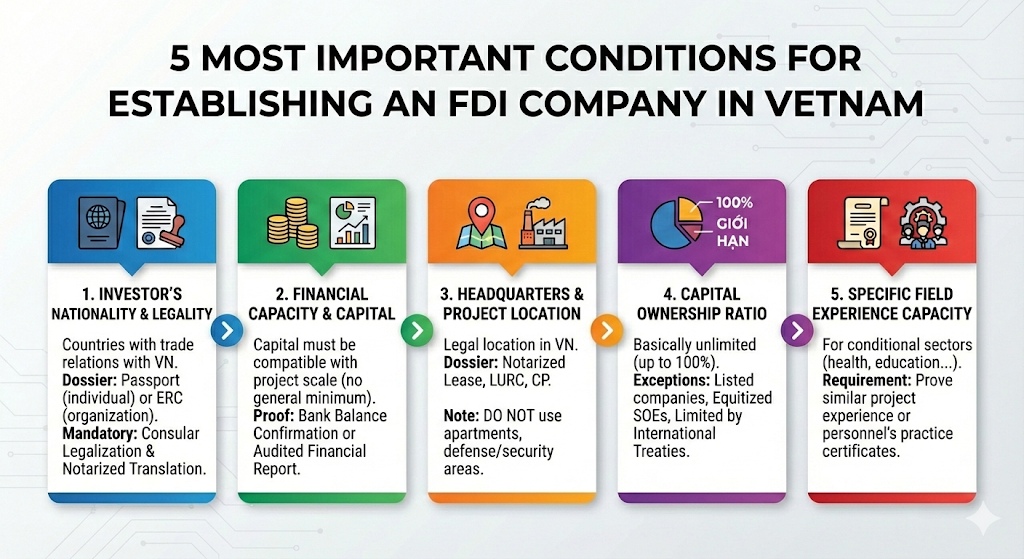
2.1. Conditions regarding nationality and legal status of the investor
This is the initial identity verification step (“Know Your Customer” in legal terms). As mentioned, investors must come from countries with normal trade relations with Vietnam. The legal application file is the key factor.
- For individuals: A valid Passport is required.
- For organizations: A Business License or Certificate of Incorporation in the host country is required.
- Important Note: All these foreign language documents must be “Consularly Legalized” at the Vietnamese diplomatic mission abroad, then notarized and translated into Vietnamese to have legal validity for submission.
2.2. Strict regulations on financial capacity and charter capital
Vietnamese law does not stipulate a general minimum capital level for all industries when establishing an FDI company (except for specific industries such as real estate, education, or banking). However, the licensing authority will appraise the compatibility between the registered capital and the scale of the project. Investors must prove their financial capacity to implement the project. This is shown through:
- Bank balance confirmation (for individuals).
- Audited financial statements for the last 02 years (for organizations). This capital must ensure feasibility for implementing the business project in Vietnam, avoiding the establishment of “shell companies” or suspended projects.
2.3. Requirements for company headquarters and project location
One of the conditions for establishing an FDI company where applications are most often rejected relates to location. Investors must have a legal location to implement the project within the territory of Vietnam.
- Required documents: Notarized lease contract for house/office/factory, accompanied by the Land Use Right Certificate (Red Book) and Construction Permit of the lessor.
- Special Note: Apartments designated for residential purposes and national defense security areas are not allowed to be used as company headquarters. For manufacturing projects, investors must lease land or factories in industrial zones or industrial clusters consistent with local planning.
2.4. Conditions regarding foreign ownership ratio
The capital ownership ratio (“Foreign Room”) determines control over the enterprise. Basically, foreign investors can own unlimited charter capital (up to 100%) in economic organizations. However, there are 03 exceptions to note carefully:
- Ownership ratio in listed companies and public companies follows securities laws.
- Ownership ratio in equitized state-owned enterprises follows equitization laws.
- Ownership ratio is limited according to International Treaties to which Vietnam is a member (e.g., transport and international travel tourism sectors often limit the capital contribution ratio in joint ventures).
2.5. Conditions regarding experience capacity in specific fields
Not only money and location are needed; some conditional business lines require investors to prove professional capacity. When establishing a company operating in retail distribution, healthcare, education, or specialized commercial services, state agencies may request investors to provide application documents of experience capacity.
- Example: Having implemented similar projects abroad, or key personnel possessing appropriate practicing certificates. This is a technical barrier to ensure the quality of services provided to the Vietnamese market.
3. Process of Meeting Conditions for Establishing an FDI Company in Reality
3.1. Preparing legal application documents and economic-technical explanation
The process of realizing the conditions for establishing an FDI company begins with drafting the application file. This is the “backbone” stage, determining 80% of the success rate. The application file includes not only personal/organizational authentication, financial, and location documents but most importantly, the “Investment Project Proposal.” In this document, the investor must clearly explain the objectives, scale, land use needs, labor, environmental impact assessment, and socio-economic efficiency of the project. An unconvincing explanation will cause authorities to doubt the feasibility of establishing the foreign-invested enterprise.
3.2. Applying for the Investment Registration Certificate (IRC)
Unlike domestic enterprises, FDI companies must pass the first “gate”: applying for the Investment Registration Certificate (IRC). The application file is submitted to the Department of Planning and Investment (or the Management Board of Industrial Zones/EPZs). The statutory processing time is about 15 working days if the application file is valid. At this step, the state agency will verify whether the project meets the conditions regarding national defense security, industry planning, and international commitments. This is the stage where requests for additional explanations arise most frequently.
3.3. Carrying out procedures for the Enterprise Registration Certificate (ERC)
After holding the IRC “pass,” investors continue with enterprise establishment procedures to obtain the Enterprise Registration Certificate (ERC). This process is similar to establishing a Vietnamese-owned company, performed at the Business Registration Office. The ERC records information about the tax code, legal representative, and charter capital. Separating the IRC and ERC processes helps strictly manage state control over foreign capital flows but also means the procedure is twice as complex compared to domestic enterprises.
3.4. Seal engraving and registering investment capital bank account
After obtaining the ERC, the FDI company is officially born legally. The next step is to engrave the corporate seal. Especially important for FDI companies is opening a “Direct Investment Capital Account” (DICA) at a commercial bank licensed to trade foreign exchange. All capital contributions committed on the IRC must be transferred from abroad into this specialized account. If investors transfer money into a regular payment account, that money will not be recognized as legal capital contribution, causing huge difficulties for accounting and profit repatriation later.
3.5. Completing tax obligations and sub-licenses (if any)
Completing the company establishment is not the final destination. Enterprises need to perform initial tax procedures: declaring license tax, registering digital signatures, and e-invoices. For conditional business lines (such as retail, foreign language centers, restaurants…), FDI companies must also apply for a “Business License” or “Certificate of Eligibility for Operation” (Sub-license) before officially going into operation. Skipping these sub-licenses is a common violation causing many businesses to be heavily fined right upon startup.
4. Barriers When Reviewing Conditions for Establishing an FDI Company
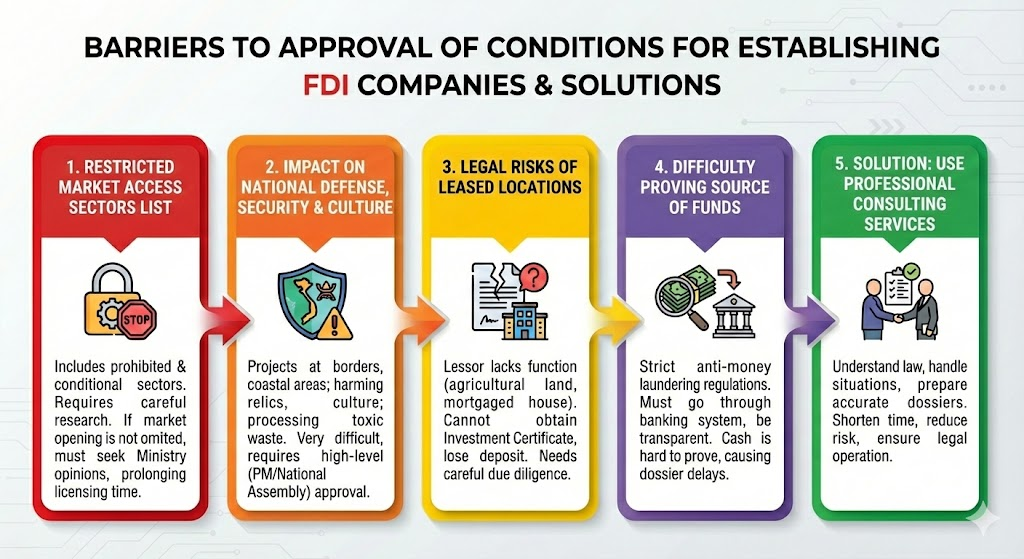
4.1. List of business lines with restricted market access
The Law on Investment 2020 issued the “List of business lines with restricted market access for foreign investors.” This list includes:
- Business lines not yet accessible to the market (Completely prohibited).
- Business lines with conditional market access. When considering conditions for establishing an FDI company, the prerequisite is to check if the intended business line is on this list. If the sector is not yet committed to opening, the investment registration agency will have to seek appraisal opinions from relevant Ministries and Branches, significantly prolonging the licensing time.
4.2. Projects affecting national defense, security, and culture
The State of Vietnam strictly controls FDI projects in sensitive locations or with specific business line. Specifically:
- Projects located in border areas, islands, coastal areas.
- Projects detrimental to historical relics, culture, and fine customs.
- Projects treating imported hazardous waste. If the project falls into these cases, meeting the conditions for establishing an FDI company is almost impossible or requires approval at a very high level (Prime Minister or National Assembly), accompanied by extremely strict environmental and security commitments.
4.3. Risks when leasing locations without clear legal documents
A “fatal” mistake of foreign investors is signing a lease contract and placing a deposit, but the lessor does not have the function to lease (e.g., agricultural land not yet converted, houses under mortgage being processed by banks, or individual houses not registered for business). The consequence is the inability to obtain an Investment Certificate, leading to loss of deposit and missed business opportunities. Therefore, legal due diligence of the lease location is an indispensable step in the process of establishing a foreign-invested enterprise.
4.4. Difficulties in proving the source of investment cash flow
In the context of increasingly tightening anti-money laundering regulations, proving financial capacity does not stop at figures. Banks and licensing agencies may request an explanation of the source of investment cash flow. Cash is usually discouraged and very difficult to prove. Cash flow must go through the banking system and be transparent. Failure to carefully prepare financial records from the host country will cause the application file review process to stall indefinitely.
4.5. Benefits of using professional consulting services
Facing a “maze” of overlapping and frequently changing legal regulations, self-implementing procedures often brings many risks and costs time for foreign investors. Using professional FDI company establishment consulting services is the optimal solution. Consultants not only thoroughly understand the conditions for establishing an FDI company but also have experience handling arising situations, supporting the drafting of accurate explanation application documents, helping shorten licensing time, and ensuring the enterprise operates lawfully from the very first days.
Fully meeting the conditions for establishing an FDI company is a solid stepping stone for foreign investors to exploit the immense potential of the Vietnamese market. Although the process and procedures for establishing a foreign-invested enterprise are still complex, with thorough preparation of legal and financial application documents and support from reputable consulting units, the door to success will always be wide open. If you have any questions about legal regulations or need all-inclusive procedural support, do not hesitate to contact us for the most effective and safe investment strategy advice.
If you have any questions, please contact our Hotline at (028) 3820 1213 or email us at [email protected] for prompt consultation and support. With an experienced team, Service thanhlap.wacontre.com is always ready to serve customers in the most enthusiastic and efficient manner. (For Japanese customers, please contact Hotline: (050) 5534 5505).