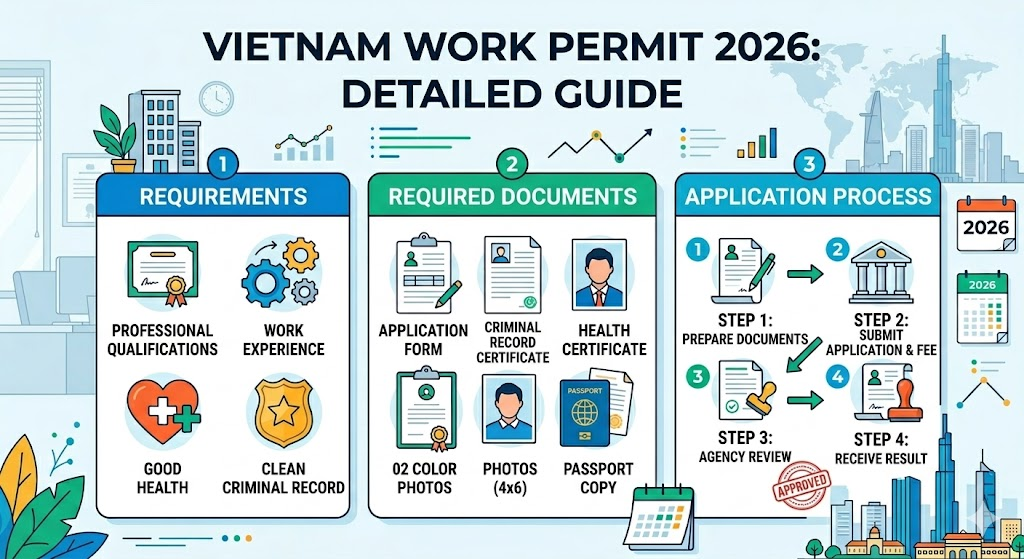
Thanks to its open economy and attractive investment policies, Vietnam is increasingly becoming a prime destination for the highly skilled global workforce. However, navigating administrative procedures can often feel frustrating. To work legally here, obtaining a “work permit” is a mandatory step for most foreign professionals. Understanding the latest legal regulations will help both businesses and expats avoid unnecessary legal risks and costly penalties. This article provides a straightforward, comprehensive guide covering everything from conditions and required documents to the standard issuance process in 2026.
- 1. Overview: What is a Work Permit and Who Needs It?
- 2. Detailed Conditions for Work Permit Issuance in 2026
- 3. Regulations on Duration and Work Permit Renewal
- 4. Exact Procedure and Documents for Work Permit Issuance
- 5. The Optimal Solution: Reputable, All-Inclusive Work Permit Services
- 5.1. Common difficulties when handling the procedure independently
- 5.2. Outstanding benefits of using professional work permit services
- 5.3. Support for complex cases and missing experience documents
- 5.4. Seamless integration with Visa and TRC procedures
- 5.5. Commitments to timelines, transparent costs, and confidentiality
1. Overview: What is a Work Permit and Who Needs It?
1.1. Concept of a work permit under current law
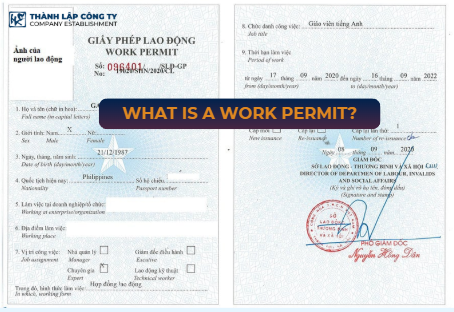
A Work Permit is an official legal document issued by the competent state labor management authority in Vietnam (the Ministry or Department of Labor, Invalids and Social Affairs) to a foreign national. This document serves as the highest proof that the foreign worker meets all standards and conditions under Vietnamese labor law to work legally within the territory of Vietnam for a specific organization or enterprise.
1.2. The importance of possessing this legal document
Owning this document is not just about passing administrative inspections; it brings core benefits. It is the sole legal basis for foreigners to sign an official labor contract, participate in insurance schemes, open a bank account to receive a legitimate salary, and pay personal income tax. Crucially, it is a mandatory document when applying for a Temporary Residence Card (TRC) valid for up to 2 years, allowing for easy entry and exit.
1.3. Detailed updates on subjects requiring a work permit
Based on Decree 152/2020/ND-CP (and its amendments), the subjects required to obtain a work permit upon entering Vietnam are diverse, including:
- Foreigners executing labor contracts for Vietnamese enterprises.
- Intra-company transferees (moving from a parent company to a subsidiary).
- Individuals executing economic, commercial, medical, or educational agreements.
- Contractual service providers or individuals entering to offer services.
- Individuals working for foreign non-governmental organizations (NGOs) or international organizations.
- Foreign managers, executives, experts, and technical workers.
1.4. The Exception: Work permit exemption through marriage
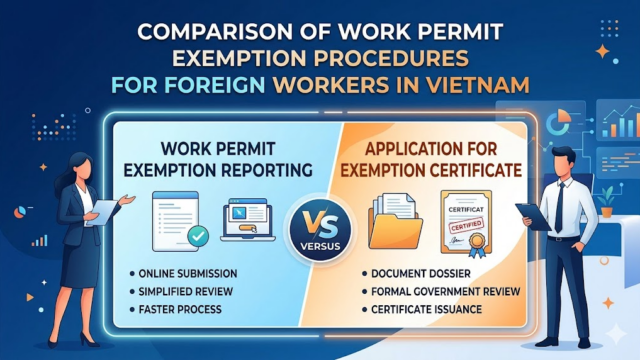
A highly humane aspect of the Labor Code 2019 is the exemption provision. Most notably, a foreigner married to a Vietnamese citizen and residing within Vietnamese territory is exempt from applying for a work permit. Instead, they only need to complete the procedure for a “Work Permit Exemption Certificate.” Businesses and employees must clearly distinguish between these two procedures (New Issuance vs. Exemption Confirmation) to prepare the correct application file and save time.
1.5. Legal consequences of working without a valid permit
Vietnamese law imposes strict penalties for illegal employment. Foreigners working without a work permit will face fines ranging from 15 to 25 million VND, alongside the additional penalty of deportation from Vietnam. For the sponsoring enterprise utilizing illegal labor, fines can reach up to 75 million VND, and their business operations may even be suspended for 1 to 3 months.
2. Detailed Conditions for Work Permit Issuance in 2026
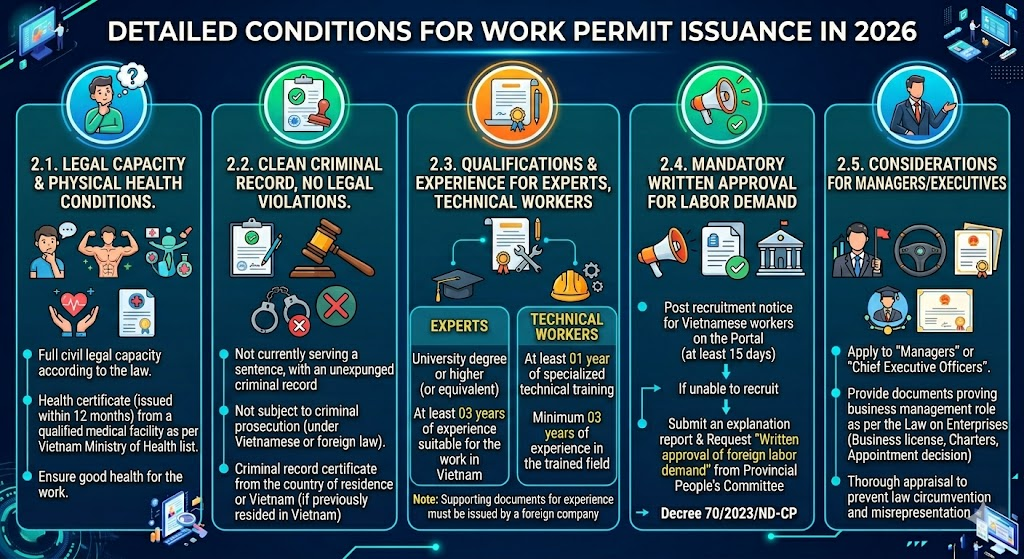
2.1. Civil capacity and physical health requirements
To ensure workforce quality, the first condition is that the foreigner must possess full civil act capacity according to the law. Additionally, they must have a Health Check Certificate (issued within the last 12 months) from hospitals or medical facilities designated by the Vietnamese Ministry of Health, proving they are physically fit for their intended position.
2.2. Clean criminal record requirement
To maintain security and order, the law requires that foreign workers must not be serving a sentence, have an unspent criminal conviction, or be facing criminal prosecution under Vietnamese or foreign law. The evidence for this is a Criminal Record Certificate (Police Check) issued by their country of residence, or a Vietnamese Criminal Record Certificate (if they have temporarily resided in Vietnam).
2.3. Qualifications and experience for experts and technical workers
Proving professional capacity is one of the strictest conditions:
- Experts: Must hold a Bachelor’s degree or higher (or equivalent) and have at least 03 years of work experience relevant to the intended job position in Vietnam.
- Technical Workers: Must have undergone at least 01 year of technical training and possess a minimum of 03 years of work experience in their trained field. All documents proving experience must be issued by overseas companies.
2.4. Mandatory approval of labor demand
This is an administrative barrier that businesses must clear before submitting the individual worker’s application file. According to updates from Decree 70/2023/ND-CP, enterprises are strictly required to post job vacancies for Vietnamese workers on the electronic portal for at least 15 days. Only if no Vietnamese candidate can be recruited may the business submit an explanation report and request a “Written Approval for the Demand to Use Foreign Labor” from the Provincial/City People’s Committee.
2.5. Notes on conditions for managers and executives
For the titles of “Manager” or “Executive Director,” the applicant must provide documents proving their managerial status in accordance with the Enterprise Law (such as a Business License containing their name, the Company Charter, or a legal Appointment Decision). Authorities scrutinize these titles very carefully to prevent companies from exploiting legal loopholes by inflating job titles to secure permits more easily.
3. Regulations on Duration and Work Permit Renewal
3.1. What is the maximum duration of a work permit?
The duration of the issued work permit is based on the proposed labor contract, the dispatch letter from the parent company, or the duration of the economic/commercial agreement. However, by law, the maximum duration for a new issuance in all cases cannot exceed 02 years. This is the standard timeframe used by state agencies to control the fluctuation of the foreign workforce.
3.2. When should businesses proceed with a work permit renewal?
As the 2-year term nears its end, if the organization still needs the personnel in the same position, the HR department must apply for a work permit renewal. Pay close attention to this critical timeline: The renewal application file must be submitted to the state authority at least 05 days, but no more than 45 days before the current permit expires. Missing this window will result in the application file being rejected.
3.3. Number of allowed renewals and related procedures
A critical limitation businesses must remember: Each work permit can only be renewed exactly 01 (one) time for a maximum extension of 02 years. Therefore, the absolute maximum time a foreigner can work continuously under one new issuance and one renewal is 4 years. After this 4-year period, the enterprise must restart the entire new issuance process from scratch.
3.4. Basic application file for renewal to continue working in Vietnam
The renewal procedure is somewhat simpler than a new issuance because it does not require resubmitting the Criminal Record or Degree/Experience certificates. The application file primarily includes: The application form for renewal, the original valid work permit, a new Health Check Certificate, the newly approved Document on labor demand, and a certified copy of the Passport. All documents must logically align with the original new issuance application file.
3.5. Risks of letting the work permit expire without renewal
If an enterprise carelessly allows the permit to expire by even a single day, the document permanently loses its eligibility for renewal. At that moment, the foreigner falls into illegal employment status. The business will face administrative fines and will have to waste time and money redoing a completely new application file (which involves the highly complex task of obtaining a new overseas criminal record). Authorizing a law firm to track these deadlines is a safe solution.
4. Exact Procedure and Documents for Work Permit Issuance
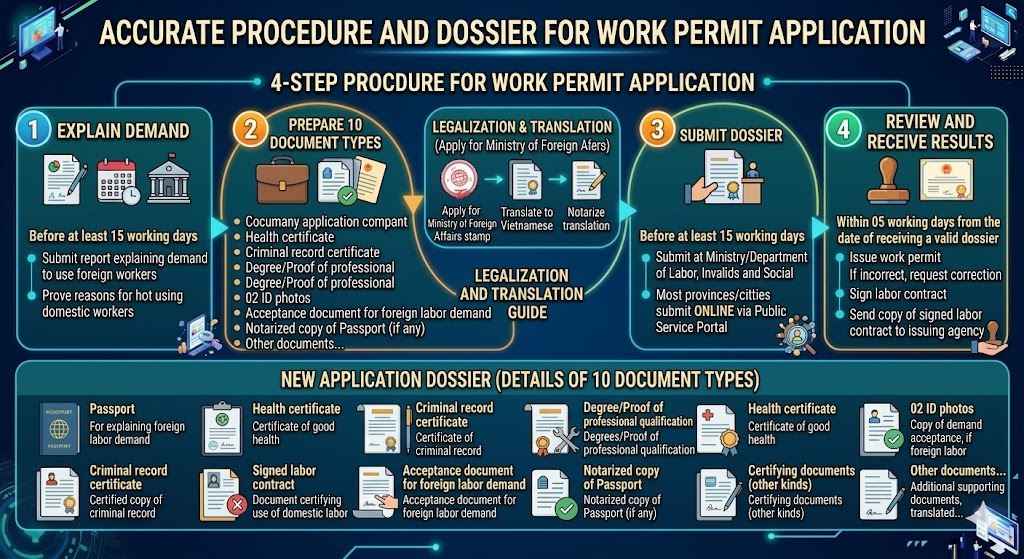
4.1. Step 1: Explain the demand for foreign labor
The first step is securing the “Quota.” At least 15 working days before the intended start date of the employee, the employer must submit an explanation report on the need for foreign labor to the Ministry of Labor, Invalids and Social Affairs (MOLISA) or the Provincial People’s Committee. This application file must clearly prove why the domestic workforce cannot meet the job requirements.
4.2. Step 2: Prepare the 10 required documents for a new issuance
Once the approval letter is granted, the enterprise begins preparing the individual’s application file. A standard set includes:
- The company’s application form for the work permit.
- Health Check Certificate (valid within 12 months).
- Criminal Record Certificate (Police Check).
- Degrees and documents proving status as a manager, expert, or technical worker.
- 02 color passport photos taken within the last 06 months.
- The original or certified copy of the Approval of labor demand.
- A certified copy of the Passport.
- Documents proving internal transfer (if applicable).
4.3. Guide to consular legalization and notarized translation
Within the application file mentioned above, there is an unbending rule: Any document issued by a competent foreign authority (such as University Degrees, Experience Confirmations, Foreign Criminal Records) has zero legal value in Vietnam unless it undergoes Consular Legalization. After obtaining the legalization stamp from a diplomatic mission, these documents must be translated into Vietnamese and undergo judicial notarization before they are eligible for submission to the Department of Labor.
4.4. Step 3: Submit the application file at MOLISA/DOLISA
After preparing a fully valid application file, the enterprise representative submits it at least 15 days before the foreigner is expected to start working. The receiving body is MOLISA (for national projects or international organizations) or the provincial/city Department of Labor, Invalids and Social Affairs (DOLISA) where the company is headquartered or where the employee actually works. Currently, most provinces require online submission via the Public Service Portal before submitting hard copies.
4.5. Step 4: Processing time and receiving the original permit
Within 05 working days from receiving a complete and valid application file, MOLISA/DOLISA will appraise it and issue the work permit. If the application file has errors, the agency will issue a written notice requesting amendments. Upon receiving the original permit, the enterprise and the employee must sign the Labor Contract, after which the enterprise is responsible for submitting 01 copy of the signed contract back to the issuing authority to complete the process.
5. The Optimal Solution: Reputable, All-Inclusive Work Permit Services
5.1. Common difficulties when handling the procedure independently
Administrative procedures involving foreign elements in Vietnam demand absolute precision. Businesses handling their own application documents often face countless hurdles: Labor demand explanations rejected for lacking valid reasoning, foreign experience proofs not meeting the exact formatting requirements, missing the consular legalization step, or enduring multiple trips to amend files all of which severely stall the foreign expert’s workflow.
5.2. Outstanding benefits of using professional work permit services
Instead of leaving your HR department to wrestle with legal red tape, utilizing a reputable work permit service is a smart investment. Legal experts will represent your business and handle the entire process from A to Z: providing advice on reasonable explanations, reviewing the legality of degrees, and representing you in submitting and receiving results. You save weeks of time, ensuring your experts start work on schedule without any lingering legal risks.
5.3. Support for complex cases and missing experience documents
In business reality, many application documents are imperfect. For instance: An expert has practical experience but lacks a Bachelor’s degree; or their former overseas company has gone bankrupt, making it impossible to get an experience confirmation. These “difficult” cases are highly prone to rejection by state agencies. Drawing on extensive experience, work permit service providers offer alternative solutions and draft sharp explanation letters to ensure the application file is legally approved.
5.4. Seamless integration with Visa and TRC procedures
The work permit is merely the first step in the legal residency chain. Afterward, the foreigner must convert their Visa and apply for a Temporary Residence Card (TRC) to reside legally long-term. By choosing a professional legal consulting service, clients receive an integrated, one-stop solution for all these procedures. The service provider will track work permit renewal deadlines and automatically handle Visa and TRC renewals, allowing businesses to manage their foreign workforce comprehensively and stress-free.
5.5. Commitments to timelines, transparent costs, and confidentiality
Our professionalism is reflected in our golden commitment: Delivering permits exactly on the prescribed timeline and ensuring the highest approval rate. All costs including service fees, translation, legalization, and state fees are quoted as a transparent, all-inclusive package in the contract, with absolutely no hidden charges. Furthermore, all personal data of the experts and internal company information are kept strictly confidential.
If you have any questions, please contact our Hotline at (028) 3820 1213 or email us at [email protected] for prompt consultation and support. With an experienced team, Service thanhlap.wacontre.com is always ready to serve customers in the most enthusiastic and efficient manner. (For Japanese customers, please contact Hotline: (050) 5534 5505).