

Starting a business and building a brand under your own name is the dream of many entrepreneurs. However, complex administrative and legal barriers often make the first steps arduous. Preparing documents incorrectly not only delays the market launch schedule but also hides many future tax risks. Therefore, researching and choosing a reliable legal partner to entrust with this process is a wise move. The article below will provide you with the most comprehensive view of the procedures and optimal solutions when starting a business.
- 1. What are Company Formation Services and Why Should You Use Them?
- 2. Consulting on Choosing a Business Entity Before Using Services
- 2.1. Legal characteristics of a Single-Member Limited Liability Company (LLC)
- 2.2. Basic regulations on Multi-Member Limited Liability Companies
- 2.3. The massive capital mobilization advantage of a Joint Stock Company (JSC)
- 2.4. Specific asset liability of a Private Enterprise
- 2.5. Market expansion solutions: Branches and Representative Offices
- 3. Standard Process of Professional Company Formation Services
- 3.1. Receiving information and preliminary consulting
- 3.2. Drafting the application file and necessary legal documents
- 3.3. Representing the enterprise to submit the application file to the DPI
- 3.4. Handing over the Business Registration Certificate and Company Seal
- 3.5. Supporting mandatory tax procedures post-establishment
- 4. Criteria for Evaluating a Reputable Company Formation Service
1. What are Company Formation Services and Why Should You Use Them?
1.1. Concept of all-inclusive company formation services
What are company formation services? Simply understood, this is a legal solution provided by law firms or accounting consulting firms to represent individuals and organizations in carrying out all administrative procedures with State agencies. This covers everything from initial consultation, drafting documents, and submitting application documents, to receiving the Enterprise Registration Certificate and completing initial tax procedures. Clients only need to provide their ideas and personal identification documents; all complex legal issues are handled comprehensively by a team of experts.
1.2. Self-incorporation vs. Hiring legal services
When deciding to start a company, you can either navigate the procedures yourself or hire a service. If you do it yourself, you will have to study the Enterprise Law 2020, draft dozens of forms, and make multiple trips to the Department of Planning and Investment (DPI) to submit and amend documents if there are errors. Conversely, when using a service, you are “buying” experience and professionalism. All risks of documentation errors are completely eliminated, ensuring the work schedule is absolutely guaranteed.
1.3. Maximizing time savings and avoiding opportunity costs
Time is an entrepreneur’s most valuable asset. Stumbling through the company registration process can rob you of weeks, delaying negotiation plans with partners or finalizing lease agreements. Using company formation services helps you save this golden time. The cost of the service is actually very small compared to the opportunity costs you might lose if you do it yourself and encounter unnecessary legal snags.
1.4. Ensuring absolute legality when registering a company
Legal regulations in Vietnam are frequently updated and supplemented. Failing to promptly grasp the latest Decrees and Circulars can easily lead to incorrectly declaring industry codes, violating charter capital regulations, or drafting a flawed company charter. A team of legal specialists with deep professional expertise will ensure your application file is 100% accurate, strictly complying with all state agency regulations, thereby creating a solid legal foundation for your enterprise.
1.5. Receiving initial business strategy consulting from experts
A reputable company formation service provider does not merely run administrative errands. They act as true advisors. Before submitting your application file, you will receive detailed advice on how to name your company to avoid duplication, how to register a reasonable charter capital to optimize the business license tax, and how to choose industry codes that align with your long-term development orientation. These are immense added values that a DIY approach cannot provide.
2. Consulting on Choosing a Business Entity Before Using Services
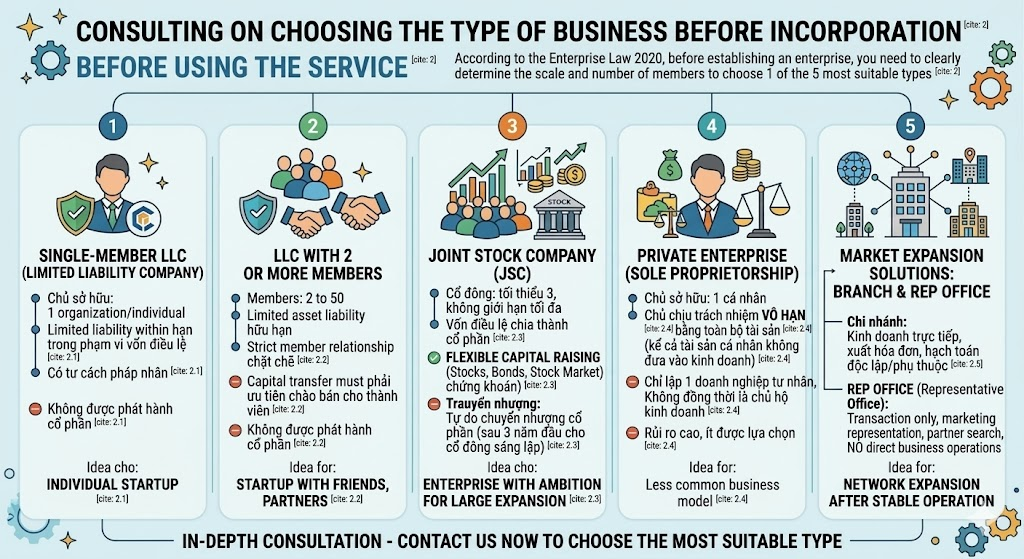
According to the Enterprise Law 2020, before establishing a business, you need to clearly determine the scale and number of members to choose the most suitable one among 5 types of entities. Below are the characteristics of each type:
2.1. Legal characteristics of a Single-Member Limited Liability Company (LLC)
A single-member LLC is an entity owned by a single organization or individual. The biggest advantage is that the owner is only liable for the company’s debts and other property obligations within the limit of the committed charter capital. This enterprise has legal entity status from the date the License is issued. However, the disadvantage is that a single-member LLC does not have the right to issue shares to raise public capital. This is an ideal model for solo startups.
2.2. Basic regulations on Multi-Member Limited Liability Companies
If you plan to start a company with friends or partners (from 2 to 50 members), this is the most popular choice. Members can be individuals or organizations, and similarly, are only liable for assets within the limit of their contributed capital. The bond between members is quite tight; transferring capital to outsiders must first be offered to existing members. Like the single-member LLC, this entity is also not allowed to issue shares.
2.3. The massive capital mobilization advantage of a Joint Stock Company (JSC)
A Joint Stock Company requires a minimum of 03 founding shareholders and has no maximum limit. The charter capital is divided into equal parts called shares. The biggest strength of this entity is its extremely flexible capital mobilization capability through the issuance of stocks and bonds, and the opportunity to list on the Stock Exchange. Shareholders have the freedom to transfer shares (except for the first 3 years for founding shareholders). This is an ideal model for businesses with ambitions for large-scale expansion.
2.4. Specific asset liability of a Private Enterprise
A private enterprise is owned by a single individual, and the core difference is that the business owner must bear unlimited liability with all their assets (including personal assets not brought into the business) for all activities of the enterprise. An individual can only establish one private enterprise and cannot simultaneously be the owner of a household business. Due to the high risk nature, this entity is rarely chosen by investors today when using company formation services.
2.5. Market expansion solutions: Branches and Representative Offices
When an enterprise is operating stably and wants to reach its tentacles into other provinces, you do not need to establish a new enterprise. At this point, you can set up a Branch or a Representative Office (RO). A branch has a direct business function, can issue invoices, and accounts independently or dependently. Meanwhile, an RO only performs transaction functions, represents marketing, and seeks partners without directly conducting profitable business. Depending on your goals, specialists will advise you on the appropriate choice.
3. Standard Process of Professional Company Formation Services
3.1. Receiving information and preliminary consulting
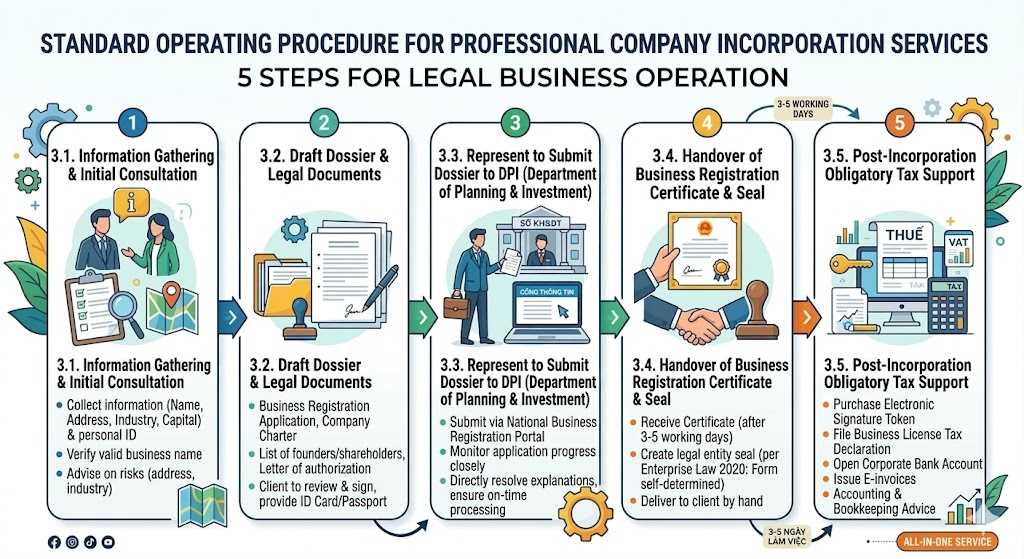
Every professional company registration process begins with listening to the client. Specialists will collect basic information: Proposed company name, head office address, main business lines, and desired charter capital. Based on this information, experts will search for the validity of the company name on the national system, advise on address risks (e.g., apartments cannot be used as headquarters), and redirect information that does not comply with current laws.
3.2. Drafting the application file and necessary legal documents
After agreeing on the information, the company formation service provider will proceed to draft a complete legal application file. The application file usually includes: Application for enterprise registration, Company Charter (drafted tightly to avoid future internal disputes), List of members/shareholders, and Power of Attorney. Clients only have to review the information one last time, sign, and provide a certified true copy of a valid ID card/Citizen ID or Passport.
3.3. Representing the enterprise to submit the application file to the DPI
With a legal Power of Attorney, legal staff will represent the client to carry out the entire working process with state agencies. Currently, application submission is mainly done through the National Business Registration Portal. Specialists will closely monitor the appraisal progress of the Business Registration Office, directly explain if requested by state officials, and ensure the application file is approved on time without the client having to travel exhaustively.
3.4. Handing over the Business Registration Certificate and Company Seal
Typically, after 3 to 5 working days from submitting a valid application file, the DPI will issue the Enterprise Registration Certificate. As soon as the license is available, the service unit will proceed with the procedure to engrave the round legal seal for the company. A progressive point of the Enterprise Law 2020 is that enterprises have the right to decide the form and quantity of seals themselves and do not need to perform the procedure to notify the seal sample. The complete set of results, including the License and Seal, will be handed directly to the client.
3.5. Supporting mandatory tax procedures post-establishment
Holding the license in your hand is only completing 50% of the journey of starting a company. For the enterprise to operate legally and issue invoices, it is mandatory to perform initial tax procedures. An all-inclusive company formation service will support clients in subsequent tasks such as: Purchasing a digital signature (Token), filing the business license tax declaration, registering a bank account with the tax authority, completing procedures to issue electronic invoices, and advising on an appropriate accounting regime.
4. Criteria for Evaluating a Reputable Company Formation Service
4.1. Check the capacity and practical experience of the provider
The market currently has countless individuals and organizations offering business establishment procedures. To be safe, choose units that are Law firms or companies specializing in Accounting – Tax services with clear legal entity status. Research their capacity profile, years in operation, and reviews from past clients. An experienced unit not only works fast but also knows how to flexibly handle “difficult” application file situations (like foreign shareholders, conditional business lines, etc.).
4.2. Transparency and clarity in cost quotations
Cost is always a top concern when registering a company. A reputable service will provide you with an all-inclusive quotation, detailing each item: what are the fees paid to state agencies, what is the service fee, seal engraving fee, information announcement fee, etc. This transparency helps you avoid situations of “hidden fees” arising during the implementation process. Demand a clear service contract before making any payments.
4.3. Commitment to accuracy regarding completion time
Your business plan and choice of grand opening day depend heavily on the progress of obtaining the license. Therefore, completion time is a vital criterion when choosing a company formation service. A professional unit will dare to commit in writing to the number of working days to deliver results. Of course, allowances must be made for national network maintenance, but they must be responsible for notifying and updating the progress continuously so you can proactively arrange your work.
4.4. After-sales support policies and legal advice
A good partner is someone who accompanies you even after the contract ends. After opening the company, you will face countless issues regarding operations, labor contracts, social insurance, and quarterly/annual tax reports. Prioritize choosing units capable of providing all-inclusive accounting services and regular legal advice. This continuous support helps your young enterprise focus with peace of mind on profitable business rather than worrying about the books.
4.5. Beware of ultra-cheap, low-quality services
The internet is full of advertisements for company formation for only a few hundred thousand VND. However, “you get what you pay for”; these ultra-cheap services often cut out important steps (like not including state fees, not paying the national information announcement fee, leaving clients to handle initial tax procedures themselves). The consequence is that your enterprise could be fined millions of VND in its very first month of operation due to late submission of the license tax declaration. Be wise and invest in peace of mind.
Starting a business journey always requires a solid legal foundation. Instead of letting complex paperwork erode your entrepreneurial enthusiasm, choosing an all-inclusive, professional company formation service is the smartest, most economical, and safest investment move. Hopefully, with the detailed sharing above about business entities, implementation processes, and how to evaluate services, you are fully equipped to confidently turn your ideas into reality. If you need any legal or accounting support, do not hesitate to contact us for completely free consultation!
If you have any questions, please contact our Hotline at (028) 3820 1213 or email us at [email protected] for prompt consultation and support. With an experienced team, Service thanhlap.wacontre.com is always ready to serve customers in the most enthusiastic and efficient manner. (For Japanese customers, please contact Hotline: (050) 5534 5505).