
Dissolving a Foreign-Invested Enterprise (FDI) is not merely about closing an office. It is a prolonged legal and financial “battle” that requires coordination among at least four governmental authorities. According to the latest 2026 Decrees, the dissolution process has been fully digitized, yet tax post-audits and employee obligations have been significantly tightened.
- 1. Legal Conditions for Dissolution of FDI Companies in 2026
- 2. Difference Between Voluntary and Compulsory Dissolution
- 3. Detailed 6-Step Dissolution Process (2026 Update)
- Step 1: Approval of the Dissolution Resolution/Decision
- Step 2: Public Announcement of Dissolution
- Step 3: Tax and Customs Finalization (The Most Challenging Stage)
- Step 4: Termination of Investment Project (Revocation of IRC)
- Step 5: Seal Return and Cancellation Procedures
- Step 6: Submission of Final Dissolution Application file (Closing the ERC)
- 4. Tax and Customs Finalization: The “Bottleneck”
- 5. Obligations to Employees and Social Insurance
- 6. Common Risks and Penalties
- 7. Comprehensive FDI Dissolution Services at Wacontre
1. Legal Conditions for Dissolution of FDI Companies in 2026
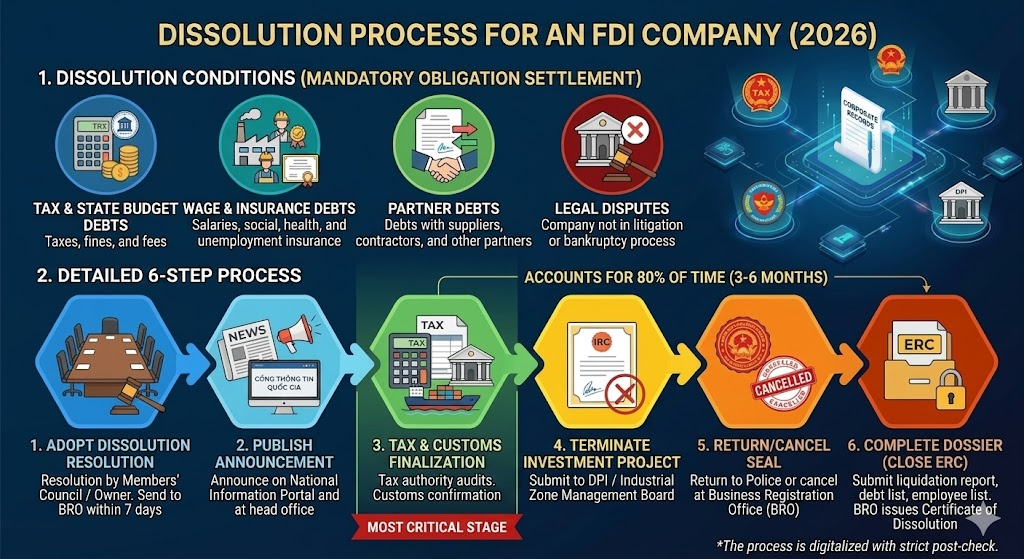
An FDI enterprise is only permitted to dissolve if it ensures the ability to settle all financial obligations. Specifically:
- Tax and State Budget Debts: Must be fully finalized (including late payment interests and penalties, if any).
- Salaries and Insurance: Social Insurance (SI) books must be closed, and all salaries and allowances must be paid to employees.
- Creditor Debts: Must have written confirmation of debt finalization or a debt settlement agreement with creditors.
- Dispute Status: The company must not be involved in any ongoing litigation in any Court or Arbitration.
2. Difference Between Voluntary and Compulsory Dissolution
- Voluntary Dissolution: Decided by the owner (Foreign Investor) when the project ends, business is inefficient, or there is a change in strategy.
- Compulsory Dissolution: Occurs when the Investment Registration Certificate (IRC) is revoked, due to serious legal violations, or when the company fails to maintain the minimum number of members required by law without converting its legal form.
3. Detailed 6-Step Dissolution Process (2026 Update)
Step 1: Approval of the Dissolution Resolution/Decision
The Owner or the Board of Members meets to approve: the reason for dissolution, deadline, procedures for contract liquidation, and debt settlement plans.
- Deadline: Submit the notification to the Business Registration Office (BRO) within 07 working days.
Step 2: Public Announcement of Dissolution
The dissolution notice must be posted on the National Business Registration Portal and publicly displayed at the headquarters to inform creditors and interested parties.
Step 3: Tax and Customs Finalization (The Most Challenging Stage)
The enterprise submits a tax finalization application file up to the time of dissolution. The Tax Authority will conduct a field audit at the enterprise’s premises (Dissolution Tax Audit).
- Note: For companies involved in import-export activities, confirmation of no outstanding customs duties must be obtained from the General Department of Customs.
Step 4: Termination of Investment Project (Revocation of IRC)
After receiving written confirmation of the completion of tax obligations, the enterprise performs procedures to terminate the investment project at the Department of Planning and Investment (or the Industrial Zone Management Board).
Step 5: Seal Return and Cancellation Procedures
Depending on the date of establishment, the enterprise returns the seal to the Police Authority or notifies the cancellation of the seal sample at the Business Registration Office.
Step 6: Submission of Final Dissolution Application file (Closing the ERC)
Submit the final application file including: List of paid creditors, list of processed employee benefits, and asset liquidation report. After 5-7 working days, the status will change to “Dissolved.”
4. Tax and Customs Finalization: The “Bottleneck”
This stage accounts for 80% of the dissolution time (usually 3-6 months). Documents must be prepared meticulously:
- Financial statements for the last 3-5 years.
- Detailed ledgers, E-invoices (Input and Output).
- Transfer Pricing (TP) documentation (if there are related-party transactions with the parent company abroad).
- Non-cash payment documents for invoices exceeding 20 million VND.
5. Obligations to Employees and Social Insurance
- Termination Notice: Must notify employees in accordance with the terms of the Labor Contract.
- Job Loss Allowance: For long-term employees (started before 2009) who are not covered by unemployment insurance.
- Closing SI Books: Must complete all insurance contributions up to the final month before the SI authority grants approval.
6. Common Risks and Penalties
- Late Tax Payment Penalties: Interests can accumulate into a massive amount if the finalization process is prolonged.
- Exit Bans: The Legal Representative (usually a foreigner) may be subject to a temporary exit ban if tax obligations are not finalized.
- Application file Rejection: Due to data discrepancies between the Tax system and the Business Registration system.
7. Comprehensive FDI Dissolution Services at Wacontre
Wacontre doesn’t just process legal papers; we solve your financial puzzles:
- Pre-Audit Accounting: We review all ledgers before submission to detect and correct potential errors.
- Legal Representation: We explain and justify on behalf of the investor to the authorities, shortening the dissolution time by half compared to self-execution.
If you have any questions, please contact our Hotline at (028) 3820 1213 or email us at [email protected] for prompt consultation and support. With an experienced team, Service thanhlap.wacontre.com is always ready to serve customers in the most enthusiastic and efficient manner. (For Japanese customers, please contact Hotline: (050) 5534 5505).