Vietnam is rising to become one of the most vibrant retail and distribution markets in the Asian region, strongly attracting the attention of foreign investors. However, to legally participate in the supply chain and conduct commercial activities here, foreign direct investment (FDI) enterprises must possess a business license for trading goods. The application file appraisal process and licensing conditions often contain many complex technical barriers. The following in-depth article will provide you with a clear, updated legal roadmap to overcome all administrative hurdles.
- 1. What is a Business License for Trading Goods and Legal Overview?
- 1.1. Concept of goods trading activities of FDI investors
- 1.2. Why do foreign enterprises need to apply for a business license for trading goods?
- 1.3. The latest legal basis governing commercial activities
- 1.4. Clear distinction between Business License and Investment Certificate
- 1.5. Practical cases mandating a business license
- 2. Current Conditions for Granting a Business License for Trading Goods
- 2.1. Requirements for foreign investors from countries with WTO commitments
- 2.2. Strict conditions for foreign investors without market opening commitments
- 2.3. Special regulations for goods not yet committed to market opening
- 2.4. Distinct conditions for distributing items like lubricating oil, rice, sugar
- 2.5. Economic Needs Test (ENT) criteria when establishing a second retail outlet
- 3. Detailed Application file and Procedures for Applying for a Business License
- 3.1. Preparing the Application Form and Comprehensive Capacity Explanation
- 3.2. Strict requirements for financial planning and tax transparency
- 3.3. Sequence of steps to submit the business license application application file
- 3.4. New update: Appraisal authority belongs to the Department of Industry and Trade
- 3.5. Actual processing time and notes to avoid application file rejection
- 4. Reputable, All-Inclusive Service for Applying for a Business License for Trading Goods
1. What is a Business License for Trading Goods and Legal Overview?
1.1. Concept of goods trading activities of FDI investors
Trading goods is defined as a basic commercial activity where the seller is obliged to transfer the goods and ownership of the goods to the buyer to receive payment; conversely, the buyer is obliged to pay and receive the goods as agreed. For foreign investors, when exercising the right to export, import, or distribute wholesale/retail goods in Vietnam, they are subject to specific legal regulations aimed at protecting the domestic market.
1.2. Why do foreign enterprises need to apply for a business license for trading goods?
Unlike 100% domestic capital enterprises that freely engage in commercial business, economic organizations with foreign investment capital wanting to perform retail distribution of goods, or provide logistics/e-commerce services, are mandatorily required to apply for a business license for trading goods. This is a macroeconomic management tool of the State to control the penetration level of foreign capital, ensure fair competition with domestic enterprises, and protect consumer rights. Operating without this license will result in severe administrative fines and the suspension of business activities.
1.3. The latest legal basis governing commercial activities
The legal framework directly regulating this process currently is Decree 09/2018/ND-CP (replacing the old Decree 23/2007/ND-CP). This decree details the goods trading activities and activities directly related to goods trading of foreign investors and foreign-invested economic organizations in Vietnam. The introduction of Decree 09 brought many relaxations and simplifications in administrative procedures but simultaneously clarified technical barriers for sensitive commodities.
1.4. Clear distinction between Business License and Investment Certificate
Many businesses frequently confuse these legal documents. The Investment Registration Certificate (IRC) records investment project information. The Enterprise Registration Certificate (ERC) is the legal birth certificate of the entity. Meanwhile, the Business License for trading goods is a specialized “sub-license.” It is only issued after the enterprise has obtained its ERC and IRC (if any), serving as proof that the company is fully capable of performing distribution and retail functions in the Vietnamese market.
1.5. Practical cases mandating a business license
By law, FDI enterprises must execute the procedure to apply for a business license when conducting any of the following activities: Exercising the retail distribution right; Exercising the import or wholesale distribution right for goods not yet committed to market opening (like lubricating oils/greases); Providing logistics services; Leasing goods; Providing trade promotion, commercial intermediary, or e-commerce services. If only exercising the export right and wholesale import right for committed commodities, this license is not required.
2. Current Conditions for Granting a Business License for Trading Goods
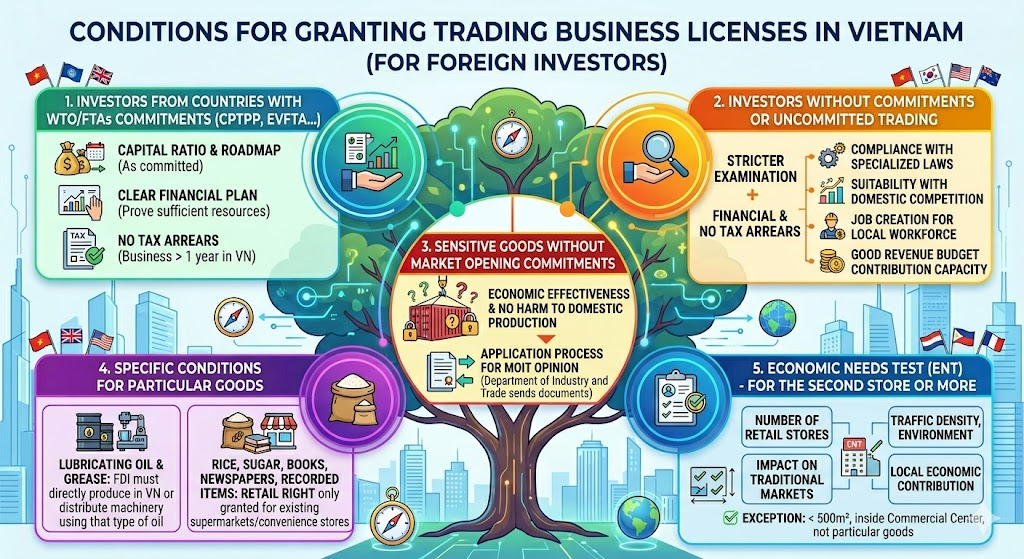
2.1. Requirements for foreign investors from countries with WTO commitments
If the foreign investor holds the nationality of countries/territories participating in international treaties to which Vietnam is a member (like WTO, CPTPP, EVFTA) and has market opening commitments for goods trading activities, the conditions are more relaxed. Specifically, they must comply with the capital ownership ratio and opening roadmap committed in the Treaty; possess a clear financial plan proving sufficient resources to implement distribution activities; and crucially, have no overdue tax debts (for enterprises established in Vietnam for 1 year or more).
2.2. Strict conditions for foreign investors without market opening commitments
In cases where the foreign investor comes from a country without market opening commitments with Vietnam, or is trading in uncommitted services, state agencies will appraise the application file more strictly. Besides financial and tax conditions, the enterprise must explain and meet supplementary criteria such as: Business operations must comply with specialized laws; Must align with the competitiveness of domestic enterprises in the same sector; Positively contribute to creating jobs for domestic labor; and possess good capacity to contribute to the state budget.
2.3. Special regulations for goods not yet committed to market opening
For sensitive goods not yet committed to market opening in international treaties, the Vietnamese State strictly controls the issuance of business licenses for trading goods. Similarly, the investor must prove economic efficiency and competitiveness that does not harm domestic production. Considering licensing in this case usually requires the Department of Industry and Trade to seek direct written approval from the Ministry of Industry and Trade and relevant specialized ministries before making a final decision.
2.4. Distinct conditions for distributing items like lubricating oil, rice, sugar
The law stipulates specific technical barriers for certain special commodities. For lubricating oils/greases: Wholesale distribution and importation are only considered for licensing if the FDI enterprise directly manufactures lubricating oils/greases in Vietnam, or manufactures/distributes machinery and equipment that utilize that specific type of oil/grease. For items like rice, sugar, books, newspapers, magazines, and recorded media: Foreign-invested economic organizations are only granted retail distribution rights if they have already established supermarket or convenience store systems, and retail is strictly limited to those specific outlets.
2.5. Economic Needs Test (ENT) criteria when establishing a second retail outlet
When an FDI enterprise wants to establish its first retail outlet, the conditions are fairly simple (only requiring a financial plan, no tax debt, and an appropriately planned location). However, if wanting to establish a retail outlet beyond the first one (from the second outlet onwards), the enterprise will face the ENT (Economic Needs Test) barrier. The ENT Council will evaluate criteria such as: The number of existing retail outlets in the geographic area; Impact on traditional markets; Traffic density, environment; and Contribution to the local economy. Only upon passing this ENT will the enterprise be permitted to expand the chain. The sole exception not requiring an ENT is a retail outlet with an area under 500m2, located within a shopping center, and not dealing in the list of special commodities.
3. Detailed Application file and Procedures for Applying for a Business License
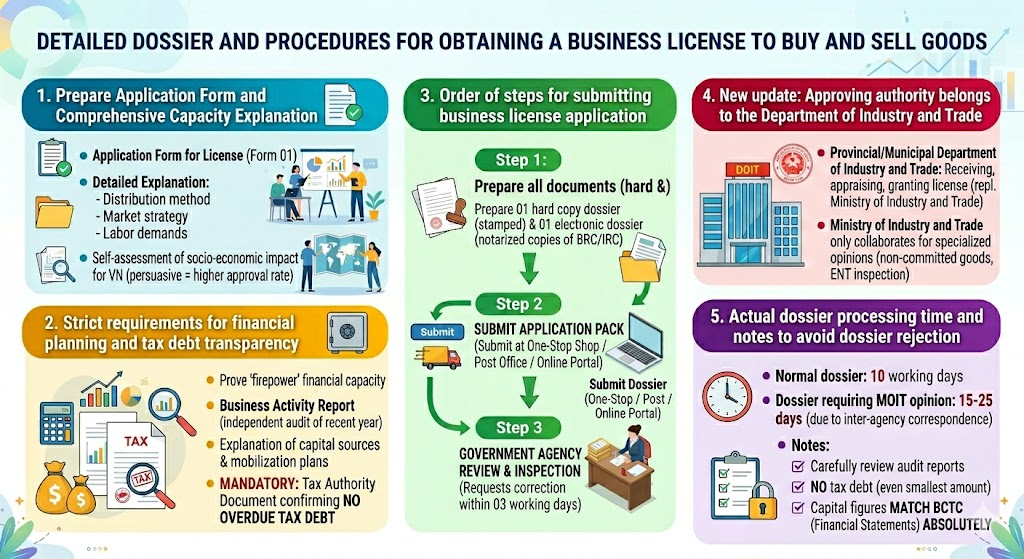
3.1. Preparing the Application Form and Comprehensive Capacity Explanation
The first core component in the business license application application file is the Application Form for the License (according to Form 01, Appendix of Decree 09/2018/ND-CP). Accompanying it is an extremely detailed Explanation Report. In this report, the enterprise must meticulously describe the method of implementing distribution activities; market development strategy; labor recruitment needs; and crucially, self-evaluate the socio-economic impacts and efficiencies this business plan brings to Vietnam. The more persuasive the explanation, the higher the approval rate.
3.2. Strict requirements for financial planning and tax transparency
The enterprise must prove it has enough financial “firepower” to maintain the retail system and trading activities. The application file needs a Report on business results based on independently audited financial statements of the most recent year (if the company has been operating for 1 year or more). Accompanied by a detailed explanation document regarding capital sources and capital mobilization plans (bank loans, parent company capital injection). Crucially, there must be a document (Notice or Confirmation) from the directly managing Tax Authority proving the enterprise has absolutely no overdue tax debts up to the time of submitting the business license application.
3.3. Sequence of steps to submit the business license application application file
The implementation process includes the following steps:
- Step 1: The enterprise prepares 01 hard copy application file (stamped with the company seal) and 01 electronic application file (if required). Copies of the Enterprise Registration Certificate and Investment Certificate must be certified true copies.
- Step 2: Submit the application file directly at the One-Stop Shop, via post, or through the competent authority’s online Public Service Portal system.
- Step 3: State agencies receive and check validity. If the application file is deficient, the agency will issue a notice requesting amendments and supplements within 03 working days.
3.4. New update: Appraisal authority belongs to the Department of Industry and Trade
According to legal updates from Decree 09/2018/ND-CP, a major beneficial change for businesses is the decentralization of authority. Currently, the Department of Industry and Trade in the province/city where the enterprise is headquartered is the competent authority to receive application documents, appraise, and directly issue the business license for trading goods (instead of having to submit to the Ministry of Industry and Trade as before). The Ministry of Industry and Trade now only acts as a coordinating agency, providing specialized opinions for certain application documents related to uncommitted goods or the establishment of retail outlets requiring an ENT check.
3.5. Actual processing time and notes to avoid application file rejection
For standard application documents not requiring opinions from the Ministry of Industry and Trade, the Department of Industry and Trade will review and issue the license within 10 working days from receiving a complete and valid application file. If the application file requires opinions from the Ministry of Industry and Trade (uncommitted goods), the processing time will be extended by 15 to 25 working days due to dispatch circulation between ministries. To avoid application file rejection, businesses must carefully review the audit report, ensuring there are no outstanding tax debts—even the smallest amount—and the capital figures in the explanation must absolutely match the financial statements.
4. Reputable, All-Inclusive Service for Applying for a Business License for Trading Goods
4.1. Common difficulties when self-executing business license procedures
Self-preparing an administrative application file can turn into a “nightmare” for foreign enterprises. The biggest barrier is not filling out the form, but rather drafting the socio-economic explanation to satisfy the authorities. Moreover, explaining ENT criteria when opening a chain of stores demands highly complex market research data. Application documents are frequently returned by the Department of Industry and Trade requesting multiple amendments, causing the enterprise’s store opening plans to be delayed indefinitely.
4.2. Legal services help save time and opportunity costs
Investors’ time is meant for finding premises and developing markets, not waiting around at administrative offices. By using professional services, the entire burden of the procedure to apply for a business license will be lifted by lawyers and legal specialists. This delegation helps businesses shorten the appraisal process, save months of waiting, thereby quickly bringing goods to the Vietnamese market, and optimizing cash flow and opportunity costs.
4.3. Experts supporting the drafting of a sharp business plan explanation
The core difference of a reputable service provider lies in professional capacity. Our team of legal and economic experts will directly study the enterprise’s financial data to design and draft an extremely sharp and logical Explanation of the Business Plan and Financial Plan. We know how to highlight the project’s strengths (such as advanced technology, high tax payments, significant use of local labor) so that the business license application application file easily persuades even the most demanding appraisers.
4.4. Strategic consulting to overcome the ENT test when establishing retail outlets
The challenge of expanding a retail chain (from the second store) is always the biggest hurdle for foreign retailers. With experience supporting numerous international supermarket and convenience store chains, we possess a precise methodology for evaluating ENT criteria. We will represent the enterprise to gather data on traffic, environment, and the number of traditional markets around the expected retail location, and build a defense application file before the provincial Appraisal Council to help the enterprise safely expand its supply chain.
Applying for a business license for trading goods is a mandatory legal door but contains many technical challenges for FDI enterprises. A poorly prepared application file not only wastes time but also loses golden business opportunities in the Vietnamese retail market. To eliminate all administrative risks, accelerate the licensing progress, and confidently expand your retail chain, partnering with a professional legal service company is the smartest investment.
If you have any questions, please contact our Hotline at (028) 3820 1213 or email us at [email protected] for prompt consultation and support. With an experienced team, Service thanhlap.wacontre.com is always ready to serve customers in the most enthusiastic and efficient manner. (For Japanese customers, please contact Hotline: (050) 5534 5505).