FDI (Foreign Direct Investment) plays an increasingly critical role in bringing capital, technology, and global management expertise into Vietnam. However, to fully leverage the potential of FDI, investors must understand the applicable investment forms, required conditions, legal procedures, and important considerations before entering the Vietnamese market. This article provides a comprehensive overview of foreign investment in Vietnam, especially for those planning to establish an FDI enterprise or begin an investment project here.
1. What Is Foreign Direct Investment (FDI)?
Definition and Key Characteristics of FDI
Foreign Direct Investment (FDI) refers to an investment in which a foreign investor brings capital, technology, and managerial expertise into another country to establish production or business activities for long-term profit. A defining feature of FDI is its long-term nature, where the investor typically directly participates in management and holds a certain level of control over the invested enterprise.
FDI differs from portfolio investment in that it involves more than acquiring shares—it represents a long-term commitment to the host country’s economy.
Types of FDI
FDI can take place through various forms, including:
- Establishing a wholly foreign-owned enterprise;
- Forming a joint venture with a Vietnamese partner;
- Contributing capital or purchasing shares in a domestic company;
- Entering into a Business Cooperation Contract (BCC).
In addition, some foreign companies choose to set up a branch or representative office in Vietnam. The choice of investment form depends on the investor’s strategy, business sector, and Vietnam’s legal requirements.
The Role of FDI in Vietnam’s Economy
FDI is a key driver of Vietnam’s industrialization and modernization. It creates jobs, increases state budget revenues, enhances production capacity, and enables the transfer of advanced technology and management skills. FDI also helps Vietnam expand export markets and integrate deeply into global supply chains. Thanks to FDI, many leading industries—such as electronics, textiles, and equipment manufacturing—have experienced rapid growth.
Emerging FDI Trends in Vietnam
In recent years, FDI inflows into Vietnam have shifted from labor-intensive industries to high-tech sectors, renewable energy, infrastructure, and services. New-generation free trade agreements (e.g., EVFTA, CPTPP) have strengthened Vietnam’s position as an attractive investment destination. Additionally, green investment, sustainability initiatives, and digital transformation are becoming major priorities for foreign investors entering Vietnam.
2. Common Types of FDI Enterprises in Vietnam
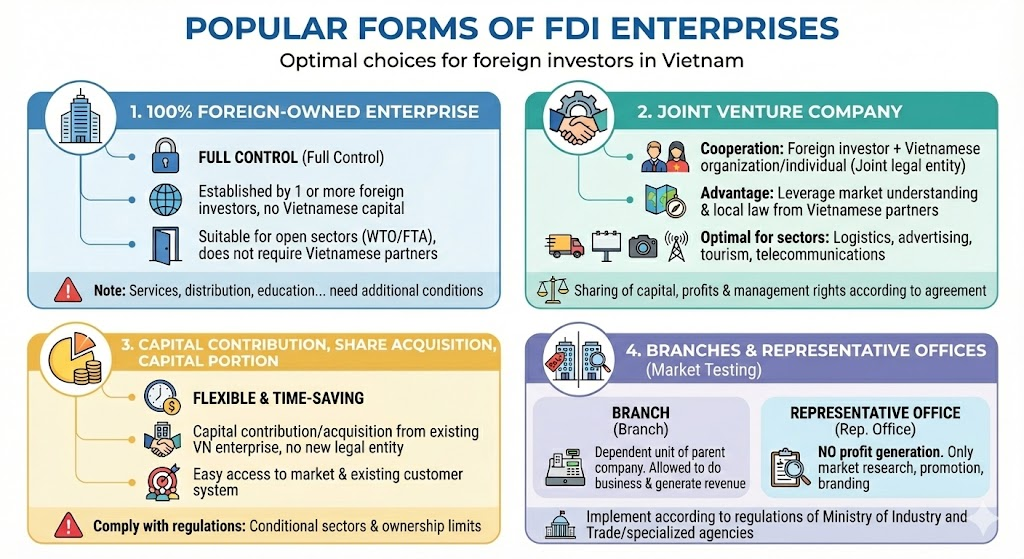
Wholly Foreign-Owned Enterprise (WFOE)
This is the most common structure for foreign investors who want full control over their business operations in Vietnam. A wholly foreign-owned enterprise is established by one or more foreign investors without any Vietnamese capital participation.
It is typically chosen for sectors that do not require a Vietnamese partner and are fully open under WTO or FTA commitments. However, investors should note that certain industries—such as services, distribution, and education—still require additional licensing conditions.
Read more: 100% Foreign Invested Company And Things To Keep In Mind
Joint Venture Company
A joint venture is formed when a foreign investor cooperates with one or more Vietnamese organizations or individuals to establish a new legal entity. This option is ideal for sectors that require Vietnamese participation, including logistics, advertising, tourism, and telecommunications. In a joint venture, both parties contribute capital, share profits, and divide management rights based on an agreed ratio. A key advantage of this model is the ability to leverage the local partner’s market knowledge and regulatory experience.
Capital Contribution, Share Acquisition, or Equity Purchase
Instead of forming a new entity, foreign investors can invest by contributing capital or acquiring shares in an existing Vietnamese company. This method is flexible, time-saving, and allows quick access to the market and an established customer base. However, share or equity acquisition must comply with investment and competition regulations, especially in conditional business sectors or those with ownership restrictions.
Read more: Foreign Investors Contributing Capital, Purchasing Shares or Equity in Vietnamese Enterprises
Branch or Representative Office
A branch is a dependent unit of a foreign parent company and is permitted to conduct business activities and generate revenue in Vietnam. A representative office, however, cannot earn profit—it may only perform market research, partner liaison, and brand promotion. This structure is suitable for investors wishing to test the market before committing to a full investment. The establishment of branches or representative offices must follow the regulations of the Ministry of Industry and Trade or other relevant authorities.
Read more: Establishing a Branch of a Foreign Company in Vietnam
3. Conditions for Foreign Investment in Vietnam
Who qualifies as a foreign investor?
A foreign investor may be an individual holding foreign nationality or an organization established under foreign laws that conducts investment activities in Vietnam. Before investing, the investor must possess full legal capacity, sufficient financial capability, and must not fall under any prohibited or restricted categories under Vietnamese law. Identifying the correct investor status is essential to determine market access conditions.
Permitted business sectors
Not all sectors in Vietnam are open to foreign investment. Vietnamese law classifies sectors into three groups: prohibited sectors, conditional sectors, and unrestricted sectors. Conditional sectors require investors to meet specific criteria, such as ownership caps, mandatory Vietnamese partners, technical standards, or minimum legal capital. The list of permitted sectors is regularly updated in the Law on Investment and Vietnam’s international commitments.
Ownership ratio and foreign ownership limits
The percentage of foreign ownership in a Vietnamese enterprise depends on the business sector, Vietnam’s WTO commitments, and other international treaties. Some sectors allow 100% foreign ownership (e.g., manufacturing, trading), while sectors such as banking, telecommunications, and transportation impose ownership caps. Exceeding the permitted threshold may result in licensing refusal or require restructuring of capital contributions.
Projects in sensitive sectors
Investment projects related to national defense, security, land use in border or island areas, or sectors affecting national interests are considered sensitive and are subject to strict appraisal procedures. Foreign investors in these areas may be required to obtain approval from relevant ministries or collaborate with qualified Vietnamese partners with appropriate legal standing and technical capacity.
4. Procedures and Documentation for Foreign Investment in Vietnam
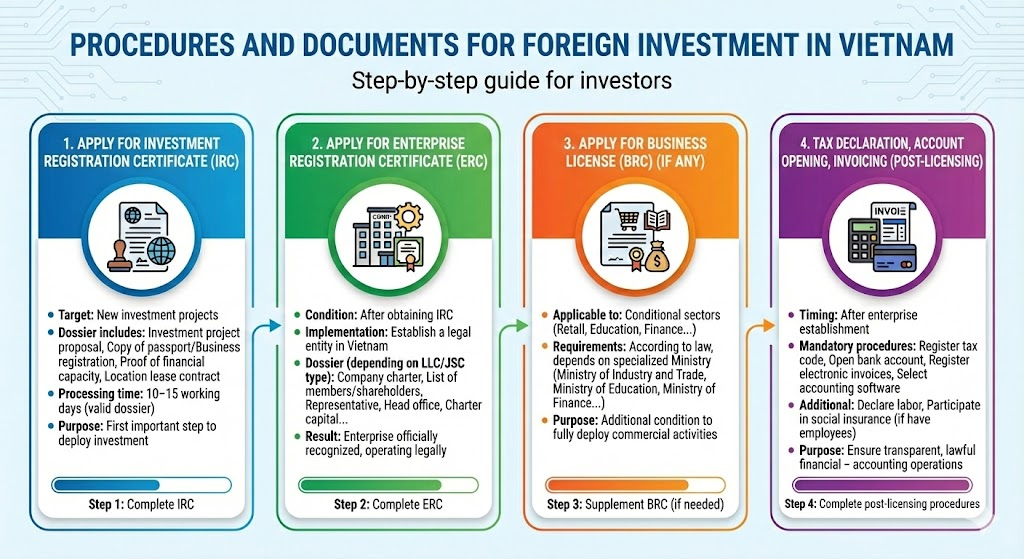
Applying for the Investment Registration Certificate (IRC)
For new investment projects, foreign investors must obtain an Investment Registration Certificate (IRC).vThe application application file typically includes:
- The investment project proposal;
- A copy of the investor’s passport or business registration certificate;
- Documents proving financial capacity;
- A lease agreement for the project location.
Processing time is usually 10–15 working days if all documents are valid. This is the first mandatory step before a foreign investor can legally implement an investment project in Vietnam.
Applying for the Enterprise Registration Certificate (ERC)
After obtaining the IRC, the investor must establish a legal entity in Vietnam by applying for the Enterprise Registration Certificate (ERC). Depending on the type of FDI enterprise (LLC, JSC, etc.), the application file may include:
- Company charter;
- List of members or shareholders;
- Information on the legal representative;
- Registered head office address;
- Charter capital details.
Once the ERC is issued, the enterprise is officially recognized and allowed to conduct business activities legally.
Applying for a Business License (if required)
For certain sectors—such as retail, education, and financial services—foreign investors must obtain an additional Business License (BRC). The required application file and approval procedures depend on the specific industry and the regulations of relevant ministries, such as the Ministry of Industry and Trade, the Ministry of Education, or the Ministry of Finance. This license is often essential for conducting full commercial operations in Vietnam.
Tax registration, bank accounts, and invoicing
After establishing the enterprise, the investor must complete the following mandatory procedures:
- Register for a tax code with the tax authority;
- Open a corporate bank account;
- Register for the use of e-invoices;
- Choose a compliant accounting software provider.
These steps ensure transparency and compliance in financial management.
Additionally, the investor must register employees with labor authorities and participate in compulsory social insurance if hiring staff in Vietnam.
Read more: Detailed Guide on Investing in Vietnam for Foreign Investors
5. Key Considerations When Investing in Vietnam
Check whether the business sector is conditional
Before making an investment decision, foreign investors must determine whether their intended business sector falls under Vietnam’s list of conditional investment sectors. This helps avoid the risk of license rejection or unexpected adjustments to the business plan. Common conditions include foreign ownership caps, requirements for a Vietnamese partner, minimum capital, or additional sub-licenses issued by specialized ministries.
Evaluate Vietnamese partners when contributing capital
If choosing a joint venture or capital contribution, selecting a reputable Vietnamese partner is critical. A local partner not only affects operational efficiency and profit-sharing but also serves as a bridge for cultural, legal, and administrative procedures. Investors should assess the partner’s financial capacity, legal status, and long-term commitment before signing any agreement.
Choose the right business structure
Not all investors should automatically choose a wholly foreign-owned enterprise. Depending on business objectives, resources, and industry characteristics, selecting the most appropriate structure—such as a joint venture, branch, or representative office—will significantly affect investment effectiveness. It is essential to evaluate levels of control, legal responsibility, and the pros and cons of each structure before making a decision.
Work with a reputable consulting firm
Vietnam’s legal environment differs significantly from many international jurisdictions. A specialized consulting firm with extensive experience in supporting foreign investors can help shorten timelines, reduce risks, and address arising issues promptly. A reliable consultant will assist with the entire process—from preparing documents to post-licensing procedures and actual business operations.
Read more: Company Formation Services – Reliable & Fast at Wacontre
Foreign investment in Vietnam offers substantial growth potential and attractive opportunities in the context of deep global integration. However, to ensure a successful FDI project and minimize legal risks, investors must understand regulatory conditions, procedural requirements, and market characteristics.
With the support of professional consulting partners like Thanhlap.wacontre.com, the investment process becomes smoother, more transparent, and more efficient—bringing your global expansion strategy closer to success in Vietnam.
If you have any questions, please contact our Hotline at (028) 3820 1213 or email us at [email protected] for prompt consultation and support. With an experienced team, Service thanhlap.wacontre.com is always ready to serve customers in the most enthusiastic and efficient manner. (For Japanese customers, please contact Hotline: (050) 5534 5505).