
During the operational lifecycle of a business, capital flow never stands still. To meet the demands of business expansion, improve bidding capacity, or handle a shortfall in initial capital contributions, owners often have to make decisions to change their charter capital. Especially for the Single-member Limited Liability Company (LLC) model, this process requires strict compliance with the provisions of the Enterprise Law 2020. Incorrect execution not only leads to application rejection but also entails tax and legal liability consequences. The article below provides the most detailed and accurate guide to this procedure.
1. Overview: What is Charter Capital and Why Change It?
1.1. Concept of Charter Capital of a Single-Member LLC
According to the Enterprise Law 2020, the charter capital of a single-member LLC upon business registration is the total value of assets the company owner commits to contribute, as recorded in the Company Charter. Contributed assets can be Vietnamese Dong (VND), freely convertible foreign currencies, gold, land use rights, intellectual property rights, technologies, technical know-how, or other assets that can be valued in VND. This amount is the initial “anchored” figure used to determine the scale of the enterprise.
1.2. Purpose of Changing Charter Capital During Business Operations
In practice, changing charter capital stems from various strategic reasons:
- Increasing Capital: When a business is thriving and needs larger capital to invest in new projects, purchase equipment, or prove financial capacity for bidding.
- Decreasing Capital: Conversely, if business operations shrink, or if the owner fails to pay the fully committed initial capital within 90 days, they are strictly required to decrease the charter capital to avoid administrative penalties.
1.3. Current Legal Basis Regulating Charter Capital Changes
All activities related to adjusting a company’s capital must strictly comply with the Enterprise Law 2020 (specifically Article 87 for single-member LLCs) and Decree 01/2021/ND-CP on enterprise registration. Non-compliance, such as falsely declaring charter capital, can lead to severe penalties from state management agencies and damage the enterprise’s reputation in the market.
1.4. Owner’s Property Liability Regarding Charter Capital
The essence of the LLC model is “limited liability.” This means the owner of a single-member LLC is only liable for the company’s debts and other property obligations within the scope of the company’s charter capital. However, if the owner fails to contribute the registered capital in full and does not carry out procedures to decrease it, they will be held liable with their entire personal assets for the company’s financial obligations arising before the date the company registers the capital change.
2. Regulations and Procedures for Increasing LLC Charter Capital
2.1. Current Legal Forms of Increasing Charter Capital
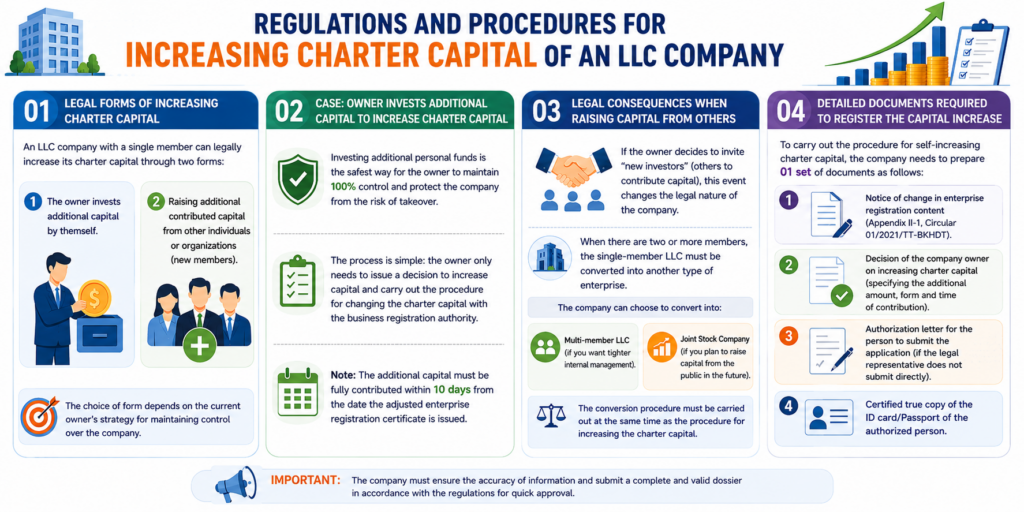
To enhance financial capacity, a single-member LLC can increase its charter capital through two legal forms:
- The company owner invests additional capital themselves.
- Mobilizing additional capital contributions from others (new individuals or organizations).
Note: The choice depends on the current owner’s business control strategy.
2.2. Case of the Owner Contributing Additional Capital
Investing additional personal funds is the safest way for the owner to maintain 100% control and protect the company from takeover risks. This process is quite simple: the owner issues a decision to increase the capital and performs the capital change procedure with the business registration authority.
Important: The additional capital must be contributed in full within 10 days from the date the adjustment of the Enterprise Registration Certificate (ERC) is completed.
2.3. Legal Consequences of Raising Capital from Others
If the owner decides to call for “new investors” (capital contributions from others), this event changes the legal nature of the enterprise. With two or more members, the single-member LLC must convert its enterprise type. The business can choose to convert into a Multi-member LLC (for strict internal management) or a Joint Stock Company (if planning to raise public capital later). The conversion procedure must be carried out concurrently with the capital increase procedure.
2.4. Detailed Dossier Required to Register Capital Increase
To self-increase charter capital, the enterprise must prepare 01 set of documents including:
- Notice of changes to enterprise registration contents (Appendix II-1, Circular 01/2021/TT-BKHDT).
- Decision of the company owner on increasing the charter capital (clearly stating the increased amount, form, and time of contribution).
- Power of Attorney for the person submitting the dossier (if the legal representative does not submit it in person).
- Valid copy of the authorized person’s personal identification documents.
3. Mandatory Cases and Procedures for Decreasing Charter Capital
3.1. Strict Conditions for Decreasing Charter Capital
Contrary to increasing capital, the procedure for decreasing charter capital is strictly controlled by law to protect the rights of creditors and partners. A single-member LLC cannot arbitrarily withdraw capital. Falsely declaring a capital decrease to evade debt obligations will result in criminal liability for the legal representative and the owner.
3.2. Mandatory Decrease Due to Failure to Contribute Full Capital
This is the most common scenario. The law stipulates that the owner has 90 days from the date of receiving the Business License to contribute the fully committed capital. If the 90 days expire without full contribution, within the next 30 days, the company is MANDATED to register a decrease in charter capital equal to the actual contributed value.
Penalty: Failure to register within this timeframe will result in an administrative fine ranging from 30 to 50 million VND according to Decree 122/2021/ND-CP.
3.3. Decrease by Partially Refunding Contributed Capital
The owner can withdraw a portion of the invested capital (refund of contributed capital) but must simultaneously meet two prerequisite conditions:
- The company has been operating continuously for more than 02 years from the date of establishment registration.
- The company must guarantee the full payment of debts and other property obligations AFTER refunding that capital portion to the owner. (This must be proven by the enterprise’s most recent Financial Statement).
3.4. Detailed Dossier Required to Register Capital Decrease
The dossier for decreasing capital is more complex due to the requirement to prove financial capacity:
- Notice of changes to enterprise registration contents.
- Decision of the owner on decreasing the charter capital.
- For capital refunds: Must include the company’s Financial Statement for the most recent period to prove the ability to pay debts after the decrease.
- Written commitment guaranteeing the full payment of debts and other property obligations after decreasing the capital.
4. Procedure for Registering Charter Capital Changes on the System
Step 1: Submit the application online
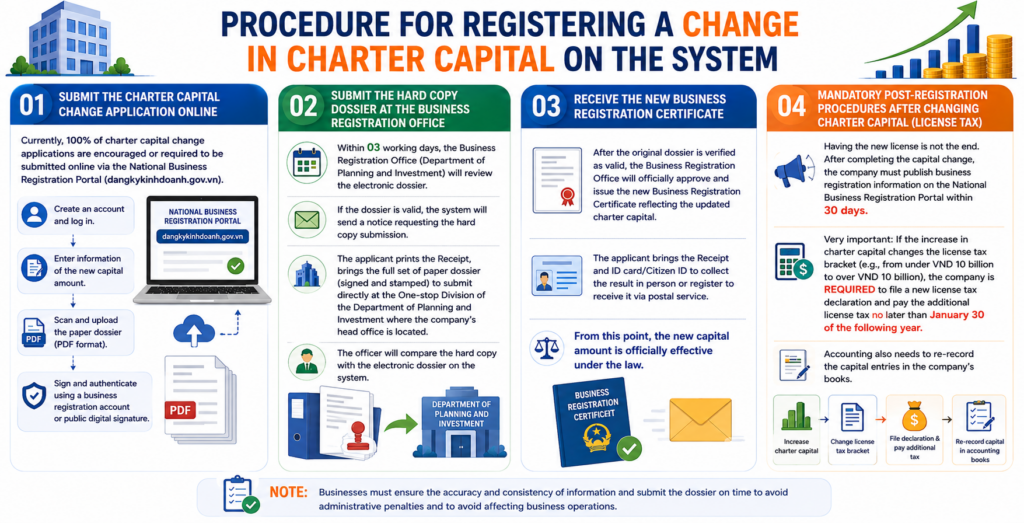
Currently, 100% of capital change dossiers are encouraged or required to be submitted online via the National Business Registration Portal (dangkykinhdoanh.gov.vn). The submitter (Owner, representative, or authorized person) creates an account, fills in the fields with the new capital level, scans the paper dossier (PDF format), and uploads it to the system. They then digitally sign it using a Business Registration Account or a Public Digital Signature.
Step 2: Submit hard copies at the Business Registration Office
Within 03 working days, the Business Registration Office (Department of Planning and Investment) will appraise the electronic dossier. If valid, the system will send a notice requesting the hard copies. The submitter prints the Receipt and brings the entire paper dossier (signed and stamped) to submit directly at the One-Stop-Shop of the Department of Planning and Investment where the company is headquartered. A specialist will cross-check the hard copy against the electronic version.
Step 3: Receive the new Enterprise Registration Certificate
After successfully cross-checking the valid original documents, the Business Registration Office will officially approve and issue a new Enterprise Registration Certificate recording the modified charter capital. The submitter brings the Receipt and their Citizen ID card to receive the results directly or via postal mail. From this moment, the new capital level officially takes legal effect.
4.4. Mandatory Post-Inspection Procedures (Business License Tax)
Getting a new license is not the final step. After completing the capital change, the enterprise must fulfill the obligation to Publicly announce the enterprise registration information on the National Portal within 30 days.
Crucial Note: If the capital increase changes the business license tax tier (e.g., increasing from under 10 billion VND to over 10 billion VND), the enterprise is MANDATED to prepare a new Business License Tax Declaration and pay the supplementary tax amount no later than January 30th of the following year. The accountant also needs to re-record the capital entries in the company’s ledger.
Changing charter capital is a crucial financial decision that directly affects the scale, reputation, and legal liability of a single-member LLC. Whether increasing capital to expand the market or decreasing it to comply with the law, businesses must thoroughly understand the dossier process to avoid the risk of rejection or penalties by authorities.
If you have any questions, please contact our Hotline at (028) 3820 1213 or email us at [email protected] for prompt consultation and support. With an experienced team, Service thanhlap.wacontre.com is always ready to serve customers in the most enthusiastic and efficient manner. (For Japanese customers, please contact Hotline: (050) 5534 5505).