With the increasing number of foreigners living and working in Vietnam, there is a huge demand for legal procedures related to immigration. However, not everyone fully understands the current regulations, leading to unfortunate misunderstandings and the risk of administrative penalties. Many clients come to us with a common question: Are the benefits of these two documents the same? This article will provide a comprehensive look at Visas and Temporary Residence Cards, helping you reside legally with peace of mind.
- 1. Overview: What are Visas and Temporary Residence Cards?
- 2. Most Accurate Criteria to Distinguish Between Visa and TRC
- 3. Regulations on Visas and TRCs under the Business Category
- 4. Guide to the Latest Visa and TRC Application Procedures
- 5. Important Notes When Using Visas and Temporary Residence Cards
1. Overview: What are Visas and Temporary Residence Cards?
To comply with Vietnamese law, the first step is to clearly understand the legal nature of each document. Although both serve the purpose of allowing foreigners to stay, Visas and Temporary Residence Cards have distinct characteristics.
What is a Visa?
A Visa (or entry visa) is a document issued by a competent authority of Vietnam, allowing a foreigner to enter the country. In the eyes of regulatory agencies, what is a Visa? It is essentially an initial “entry permit.” A Visa is usually stamped directly into the passport or issued separately (loose-leaf). Depending on the purpose of entry (tourism, visiting relatives, business, investment…), the visa will have different symbols such as DL, TT, DN, ĐT, etc.
What is a Temporary Residence Card (TRC)?
Unlike a visa, what is a Temporary Residence Card? According to the Law on Entry, Exit, Transit, and Residence of Foreigners in Vietnam, a Temporary Residence Card (TRC) is a document issued by the Immigration Department or a competent authority of the Ministry of Foreign Affairs. This card is issued to foreigners who are allowed to reside in Vietnam for a fixed period and is valid to replace a visa. Simply put, this is a form of “long-term visa” printed in the form of a hard card (similar to an ID card).
The Close Relationship Between the Two
Visas and Temporary Residence Cards have a close causal relationship. Typically, to obtain a TRC, a foreigner must first possess an entry visa with the correct purpose. For example, to obtain a Work TRC, you must enter using a Work Visa or Business Visa. The TRC is the next step to legalize a long-term stay without the need for continuous visa extensions.
Legal Basis Governing Immigration Activities
All procedures related to Visas and TRCs comply with Law No. 47/2014/QH13 and the Amended Law No. 51/2019/QH14. Mastering these legal texts helps individuals and organizations avoid unnecessary violations during their stay.
2. Most Accurate Criteria to Distinguish Between Visa and TRC
Many foreigners often mistake these two documents for the same thing. However, distinguishing between a visa and a TRC is essential to choosing the optimal plan for staying in Vietnam.
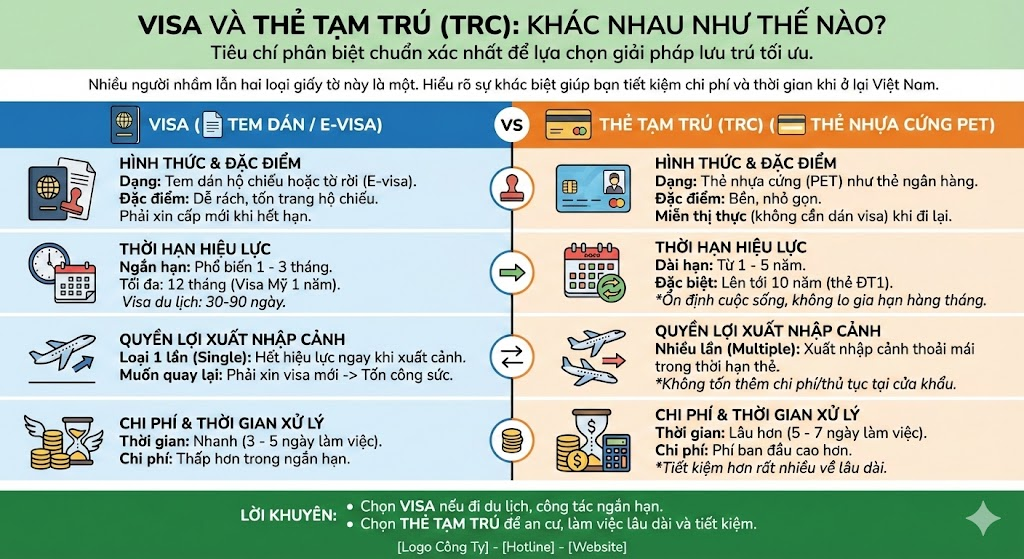
Differences in Form and Usage Value
- Visa: Usually a sticker in the passport or a separate sheet (E-visa). When the number of entries is used up or it expires, you must apply for a new one. Visas are generally more short-term.
- Temporary Residence Card: A hard plastic card (PET), the size of a bank card, with high durability. TRC holders are exempt from visa requirements when entering and exiting, meaning no visa sticker is needed for each trip.
Comparison of Maximum Validity Period
This is the biggest difference between a visa and a TRC:
- Visa: The duration is usually short, commonly ranging from 1 month, 3 months, to a maximum of 12 months (for US visas, it can be 1 year). Tourist visas are usually only valid for 30-90 days.
- Temporary Residence Card: Has a much longer duration, ranging from 1 year to 5 years, or even up to 10 years for investment TRCs (ĐT1). This helps foreigners stabilize their lives and work without worrying about monthly renewal procedures.
Differences in Immigration Privileges
When possessing a visa (single entry type), if you leave Vietnam, that visa becomes invalid immediately. To return, you must apply for a new visa. Conversely, a TRC allows you to enter and exit multiple times (Multiple entry) throughout the validity of the card without incurring any additional costs or procedures at the border.
Costs and Processing Time
- Short-term: Visa costs are lower, and processing time is faster (about 3-5 working days).
- Long-term: TRC fees are higher, and the approval time is longer (about 5-7 working days). However, if you calculate the total cost of multiple visa renewals over several years, the TRC is much more economical.
3. Regulations on Visas and TRCs under the Business Category
In the context of economic integration, the demand for foreign experts and investors is very high. Therefore, regulations on business visas and conversion to temporary residence cards are always hot topics.
What is a Business Visa and Who Qualifies?
A Business Visa (usually symbol DN) is a type of visa issued to foreigners coming to work with enterprises in Vietnam. Eligible subjects include investors, high-tech workers, experts, or those entering to execute commercial contracts. This is an important “stepping stone” to proceed toward a TRC.
Business Visa Symbols (DN1, DN2) to Remember
The new law has clearly divided the symbols:
- DN1: Issued to foreigners working with enterprises and organizations that have legal status in accordance with Vietnamese law.
- DN2: Issued to foreigners entering to offer services, establish a commercial presence, or perform other activities under international treaties to which Vietnam is a member. Understanding the correct symbol helps businesses prepare accurate sponsorship documents.
Conditions for Converting from Visa to Investment/Labor TRC
A major advantage of business visas and TRCs is the ability to change the purpose of stay right in Vietnam without exiting the country (in certain cases).
- If holding a Work Permit, a DN visa holder can switch to an LĐ symbol TRC (LĐ1, LĐ2).
- If an Investor contributing capital, they can switch to a ĐT symbol TRC (ĐT1, ĐT2, ĐT3).
Benefits When Businesses Sponsor TRCs
When an enterprise carries out procedures to apply for visas and TRCs for its personnel, they receive several benefits:
- Retaining high-quality personnel thanks to legal stability.
- Saving administrative costs and travel time for repeated procedures.
- Convenience for foreign personnel to buy apartments, register marriages, or perform other civil procedures in Vietnam.
4. Guide to the Latest Visa and TRC Application Procedures
The process of applying for a visa and TRC requires absolute meticulousness and accuracy in document preparation.
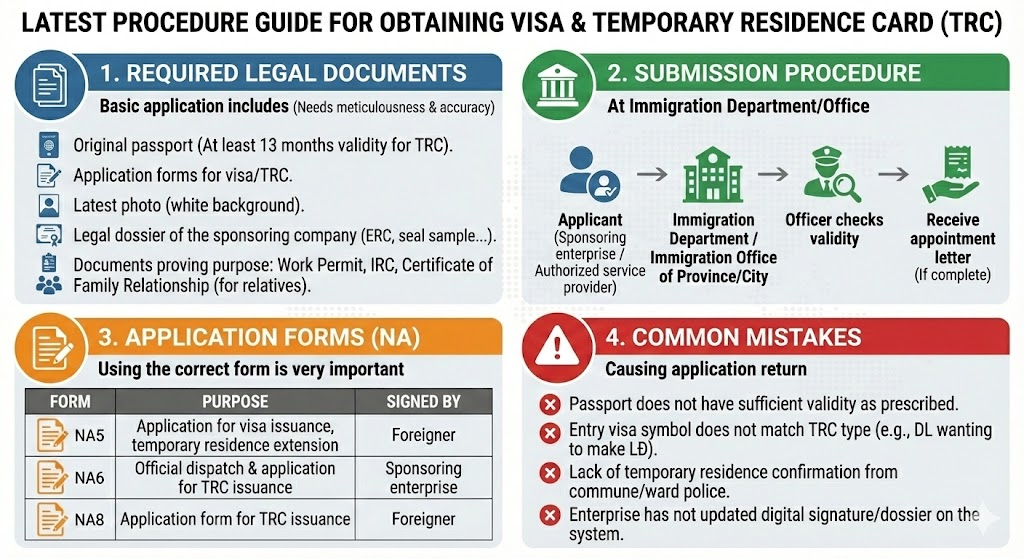
Required Legal Documents for Each Case
A basic application file usually includes:
- Original passport (valid for at least 13 months for TRC applications).
- Application forms for visa/temporary residence card issuance.
- Most recent portrait photos (white background).
- Legal entity application file of the sponsoring company (Business License, seal sample…).
- Documents proving the purpose: Work Permit, Investment Certificate, Certificate of Family Relationship (for visiting relatives).
Filing Process at the Immigration Department
The applicant (usually the administrative staff of the sponsoring company or an authorized service provider) will bring the application file to the Immigration Department or the Immigration Office of the provincial/city police where the enterprise is headquartered. Here, officers will check the validity of the visa and TRC application file. If complete, you will receive an appointment receipt for the results.
Common Application Forms (NA) Used
Using the wrong form is a basic error that many people make.
- Form NA5: Application for visa issuance, visa extension, or extension of temporary residence.
- Form NA6: Official dispatch and application for issuance of a temporary residence card for foreigners (signed by the enterprise).
- Form NA8: Application for issuance of a temporary residence card for foreigners (signed by the foreigner).
Common Mistakes Causing Application file Rejection
When applying for visas and TRCs, common errors include:
- Passport does not have enough remaining validity as required.
- Entry visa symbol does not match the type of TRC requested (e.g., entering on a Tourist DL visa but wanting to apply for a Labor LĐ card).
- Lack of temporary residence confirmation from the police of the ward/commune where the foreigner is staying.
- The sponsoring enterprise has not updated its digital signature or legal application file on the system.
5. Important Notes When Using Visas and Temporary Residence Cards
Possessing the card is not everything. Using and preserving visas and TRCs correctly is equally important to avoid legal trouble.
Regulations on Declaring Temporary Residence Locally
Even with a long-term TRC, every time a foreigner changes accommodation or is issued a new card, they must re-declare temporary residence with the local police. Currently, this can be done online quite easily. Failure to declare temporary residence is one of the main reasons why future extensions are refused.
Renewal Procedures When Documents are About to Expire
You should proactively submit a renewal application about 5-7 days before the visa or TRC expires. Do not wait until the last day, as if there are errors in the application file, you will not have time to correct them and will fall into an “overstay” situation.
Handling Lost Cards or Passports
If a TRC is unfortunately lost, the foreigner needs to immediately report it to the ward police where it was lost to obtain a Report of Loss. Then, the sponsoring enterprise needs to follow procedures to apply for a reissue at the immigration authority. Absolutely do not be negligent, because without the card, you cannot legally exit the country.
Penalties for Overstaying
Vietnam is tightening regulations on immigration. Letting a visa or TRC expire, even by just 1 day, will result in administrative penalties. The fine increases according to the number of days overstayed, ranging from a few million to tens of millions of dong. More seriously, violators may be forced to leave the country and placed on the Blacklist, banning re-entry for a long period.
In summary, Visas and Temporary Residence Cards are the two most important legal tools for foreigners in Vietnam. Understanding what a visa is, what a TRC is, and knowing how to distinguish between them will help individuals and businesses be more proactive in their residency plans. Especially for business visas, thorough preparation of documents is the key to a smooth issuance process. We hope this article has provided useful information to help you resolve your current legal inquiries.
If you have any questions, please contact our Hotline at (028) 3820 1213 or email us at [email protected] for prompt consultation and support. With an experienced team, Service thanhlap.wacontre.com is always ready to serve customers in the most enthusiastic and efficient manner. (For Japanese customers, please contact Hotline: (050) 5534 5505).