

In the context of Vietnam’s economy integrating deeply and broadly, choosing the right business model is the first important stepping stone for the success of startups. The Joint Stock Company (JSC) is currently one of the most preferred types due to its flexible capital mobilization capabilities and professional image in the eyes of partners. However, the frequently changing legal corridor confuses many investors. The article below will provide a detailed “map” of the process and procedures for establishing a joint stock company according to the latest regulations, helping you start your business with confidence.
- 1. Overview: What is a Joint Stock Company and Basic Legal Characteristics
- 1.1. Concept of a Joint Stock Company under the Enterprise Law 2020
- 1.2. Characteristics regarding Capital and Capital Mobilization Ability
- 1.3. Shareholder Structure and Liability for Assets
- 1.4. Advantages and Disadvantages of Choosing the JSC Model
- 1.5. Comparison: Joint Stock Company vs. Limited Liability Company (LLC)
- 2. Conditions for Establishing a Joint Stock Company Before Submitting Application file
- 2.1. Regulations on Naming the Company to Avoid Duplication
- 2.2. Legal Requirements for the Enterprise’s Head Office
- 2.3. Regulations on Business Lines and Level 4 Industry Codes
- 2.4. Charter Capital and Capital Contribution Deadline for Founding Shareholders
- 2.5. Minimum Number and Conditions of Founding Shareholders
- 3. Detailed Application file and Process for Establishing a Joint Stock Company
- 3.1. Preparing the Most Complete Business Registration Application file
- 3.2. Process of Online Submission via the National Portal
- 3.3. Reception and Processing Time at the Department of Planning and Investment
- 3.4. Receiving Results and Engraving the Enterprise Legal Seal
- 3.5. Things to Do Immediately After Receiving the Business License
- 4. Why Use Professional All-Inclusive Company Formation Services?
1. Overview: What is a Joint Stock Company and Basic Legal Characteristics
1.1. Concept of a Joint Stock Company under the Enterprise Law 2020
According to the Enterprise Law 2020, a Joint Stock Company is a type of enterprise in which the charter capital is divided into many equal parts called shares. The owner of shares is called a shareholder. This is the only type of enterprise that has the right to issue shares to the public to raise capital, creating a premise for listing on the stock exchange. Understanding this concept clearly is the first important step in the company establishment process to determine if this model is truly suitable for your scale and business orientation.
1.2. Characteristics regarding Capital and Capital Mobilization Ability
The most prominent characteristic of a joint stock company is the flexibility of capital flow. Charter capital is subdivided into shares, allowing many investors to contribute capital together. The capital mobilization capacity of this type is unlimited, ranging from issuing stocks and bonds to other types of securities. This creates a huge competitive advantage for businesses when needing to expand production and business scale without relying entirely on bank loans. This is the main reason why large enterprises (“Big Corps”) often choose this model.
1.3. Shareholder Structure and Liability for Assets
Shareholders can be organizations or individuals. The minimum number of shareholders is 03, and there is no maximum limit. Regarding asset liability, shareholders are only liable for debts and other property obligations of the enterprise within the amount of capital contributed to the enterprise. This limited liability regime helps minimize risks for investors when establishing a joint stock company. However, founding shareholders need to note the regulations on restricting the transfer of ordinary shares for the first 03 years from the date of licensing.
1.4. Advantages and Disadvantages of Choosing the JSC Model
The biggest advantage is the ability to raise capital widely and the high liquidity of shares (easy to buy, sell, transfer). Additionally, the management structure of a joint stock company is very tight, suitable for a modern business environment. However, the disadvantage is the cumbersome management apparatus, high operating costs, and strict compliance with information disclosure regulations, especially for public companies. Therefore, if the business scale is small with few members, you should consider carefully before deciding to establish a joint stock company.
1.5. Comparison: Joint Stock Company vs. Limited Liability Company (LLC)
Many investors often hesitate between establishing a joint stock company and an LLC. The fundamental difference lies in the number of members and the ability to raise capital. An LLC is limited to a maximum of 50 members and cannot issue shares, suitable for family business models or close partners with strict (“closed”) management. Conversely, a joint stock company is an “open” model, welcoming capital from the public. Depending on the long-term strategic vision, investors should choose the appropriate type to optimize governance and tax.
2. Conditions for Establishing a Joint Stock Company Before Submitting Application file
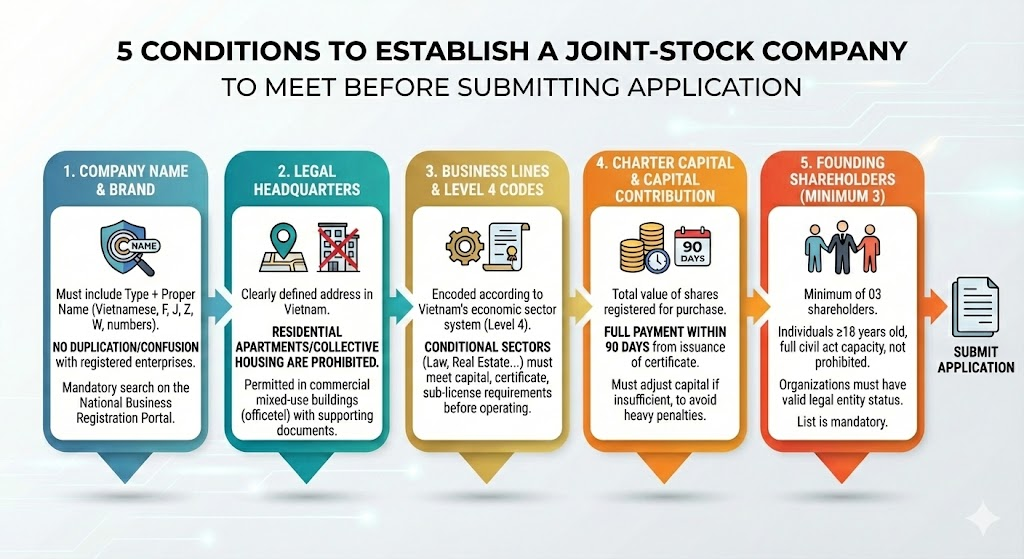
2.1. Regulations on Naming the Company to Avoid Duplication
The business name is the brand and an intangible asset. Based on Articles 37-41 of the Enterprise Law 2020, the name of a joint stock company must include two components: Type of enterprise + Proper name. The proper name is written using letters in the Vietnamese alphabet, the letters F, J, Z, W, numbers, and symbols. Most importantly, the intended name must not be identical or cause confusion with the name of a previously registered enterprise nationwide. You should look up the name on the National Business Registration Portal before preparing the application file.
2.2. Legal Requirements for the Enterprise’s Head Office
The head office is the contact point of the enterprise within the territory of Vietnam and must have a clearly defined address (House number, street name, ward/commune, district, province/city). According to the Housing Law 2014 and guiding documents, apartments designated for residential purposes and collective housing absolutely cannot be used as company headquarters. However, for mixed-use buildings (officetels) with commercial functions, you can completely place your headquarters there if you have documents proving that the area is permitted for office business.
2.3. Regulations on Business Lines and Level 4 Industry Codes
Enterprises have the right to freely conduct business in lines not prohibited by law. When establishing a joint stock company, you need to code the business lines according to the Vietnam Standard Industrial Classification (Level 4 codes). For conditional business lines (such as law, security services, real estate trading…), the enterprise must meet all conditions (legal capital, practicing certificates, sub-licenses) before officially going into operation, although these may not need to be presented at the time of business registration.
2.4. Charter Capital and Capital Contribution Deadline for Founding Shareholders
Current law does not stipulate a general minimum charter capital for joint stock companies (except for industries requiring legal capital). Charter capital is the total par value of shares sold or registered for purchase upon establishment. Founding shareholders must pay in full for the shares registered for purchase within 90 days from the date of issuance of the Enterprise Registration Certificate. If the deadline passes without full contribution, the enterprise must carry out procedures to reduce capital, otherwise, it will face heavy administrative penalties.
2.5. Minimum Number and Conditions of Founding Shareholders
To establish a joint stock company, it is mandatory to have a minimum of 03 founding shareholders (individuals or organizations). Individuals must be 18 years of age or older, have full civil act capacity, and not be prohibited from managing an enterprise (such as civil servants, persons serving prison sentences…). For shareholders that are organizations, they must have valid legal entity status. The list of founding shareholders is a crucial document required in the initial business registration application file.
3. Detailed Application file and Process for Establishing a Joint Stock Company
3.1. Preparing the Most Complete Business Registration Application file
A standard application file is the key to getting licensed quickly. The application file includes:
- Application for business registration (According to Form Appendix I-4 of Circular 01/2021/TT-BKHĐT).
- Company Charter (with full signatures of founding shareholders).
- List of founding shareholders and shareholders who are foreign investors.
- Notarized copies of Citizen ID/Passport of individual shareholders and the legal representative.
- Copy of Enterprise Registration Certificate/Establishment Decision for organizational shareholders (accompanied by power of attorney). Preparing the application file accurately word for word will help you avoid receiving multiple notices for amendment or supplementation.
3.2. Process of Online Submission via the National Portal
Currently, direct paper submission has been almost replaced by online submission. The process is as follows:
- Step 1: Create a business registration account at the National Business Registration Portal (dangkykinhdoanh.gov.vn).
- Step 2: Enter information and upload scanned documents (PDF format) to the system.
- Step 3: Authenticate using a Public Digital Signature (Token) or Business Registration Account.
- Step 4: Submit the application file and receive the Online Receipt. This is an important step in company establishment services, requiring precise system manipulation skills.
3.3. Reception and Processing Time at the Department of Planning and Investment
After receiving the Receipt, the Business Registration Office will review the validity of the application file.
- The settlement period according to regulations is 03 working days.
- If the application file is valid: The registration authority will issue the Enterprise Registration Certificate and send a notification via email.
- If the application file is invalid: A notice requesting amendment or supplementation of the application file will be issued (stating the reason clearly). The enterprise needs to amend and resubmit from the beginning. This process can be prolonged if you are not familiar with legal document drafting regulations.
3.4. Receiving Results and Engraving the Enterprise Legal Seal
After the application file is approved, the enterprise can receive the results via post or go directly to the one-stop department. Immediately after obtaining the Business License, the enterprise proceeds to engrave the round seal. A new point of the Enterprise Law 2020 is that enterprises decide on the quantity, form, and content of the seal themselves, and do not need to carry out procedures to notify the seal sample on the National Portal as before. The enterprise manages and takes responsibility for the use of its seal.
3.5. Things to Do Immediately After Receiving the Business License
Establishing a joint stock company is not the end. To avoid tax penalties, you need to perform the following immediately:
- Hang the signboard at the company headquarters.
- Purchase a digital signature (Token) for electronic tax declaration.
- Open a bank account and notify the account number to the tax authority (via Form 08 or electronic registration).
- Register for the use of electronic invoices.
- Declare and pay the license fee (newly established enterprises in 2026 are exempted from the license fee for the first year).
- Contribute capital within the committed deadline (90 days).
4. Why Use Professional All-Inclusive Company Formation Services?
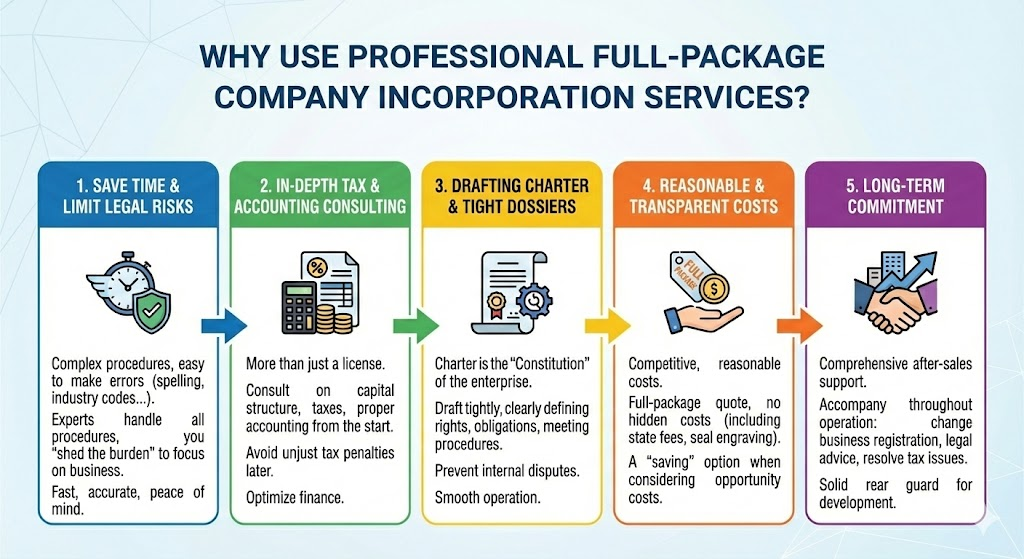
4.1. Save Time and Limit Arising Legal Risks
Although administrative procedures in Vietnam have been reformed, they are still complex for non-professionals. Figuring out how to draft application documents yourself can cost you weeks or even months of going back and forth for amendments due to small errors like spelling or industry codes. Using company establishment services helps you “shed the burden” to focus on building business strategies, while all legal procedures are handled by experts.
4.2. In-depth Consulting on Tax and Accounting After Establishment
Professional service providers don’t just help you get a license. They will advise you on the optimal capital structure, taxes to be paid, and how to account for reasonable costs right from the start. This is extremely important for joint stock companies because the accounting system for this type is much more complex than that of an LLC or household business. Correct initial advice will help businesses avoid unjust tax penalties later.
4.3. Support in Drafting Strict Charter and Internal Documents
The Company Charter is considered the “Constitution” of the enterprise. A sketchy charter (usually copied from the internet) will be the seed for internal disputes among shareholders later. Reputable joint stock company establishment services will support you in drafting a strict Charter, clearly defining rights, obligations, meeting and voting procedures, helping to protect the interests of investors and ensuring the smooth operation of the governance apparatus.
4.4. Reasonable and Transparent Service Costs
Many people are afraid of expensive service costs, but in reality, the cost for a company establishment package today is very competitive and reasonable. If you carefully calculate opportunity costs, travel efforts, and risks of errors, hiring a service is actually the more “economical” option. Reputable units always publicize all-inclusive quotes, with no hidden costs, including state fees, seal engraving fees, and service fees.
4.5. Commitment to Accompany the Enterprise Throughout Operation
The difference of a good service unit lies in after-sales support. Not stopping at handing over the license, we are committed to accompanying the enterprise throughout its operation. From changing business registration, regular legal advice, to supporting the resolution of problems with tax authorities. With a team of experienced and dedicated staff, we are confident in bringing the best legal service experience, serving as a solid rear guard for the development of your company.
Establishing a joint stock company is an exciting starting milestone but also full of legal challenges. Mastering the process and carefully preparing the application file according to the steps above will help your business have a smooth start (“well begun is half done”). If you need an all-inclusive, fast, and safe solution, do not hesitate to contact us at (028) 3820 1213. Our team of experts is always ready to listen and support you in turning your business idea into a solid legal reality.
If you have any questions, please contact our Hotline at (028) 3820 1213 or email us at [email protected] for prompt consultation and support. With an experienced team, Service thanhlap.wacontre.com is always ready to serve customers in the most enthusiastic and efficient manner. (For Japanese customers, please contact Hotline: (050) 5534 5505).