
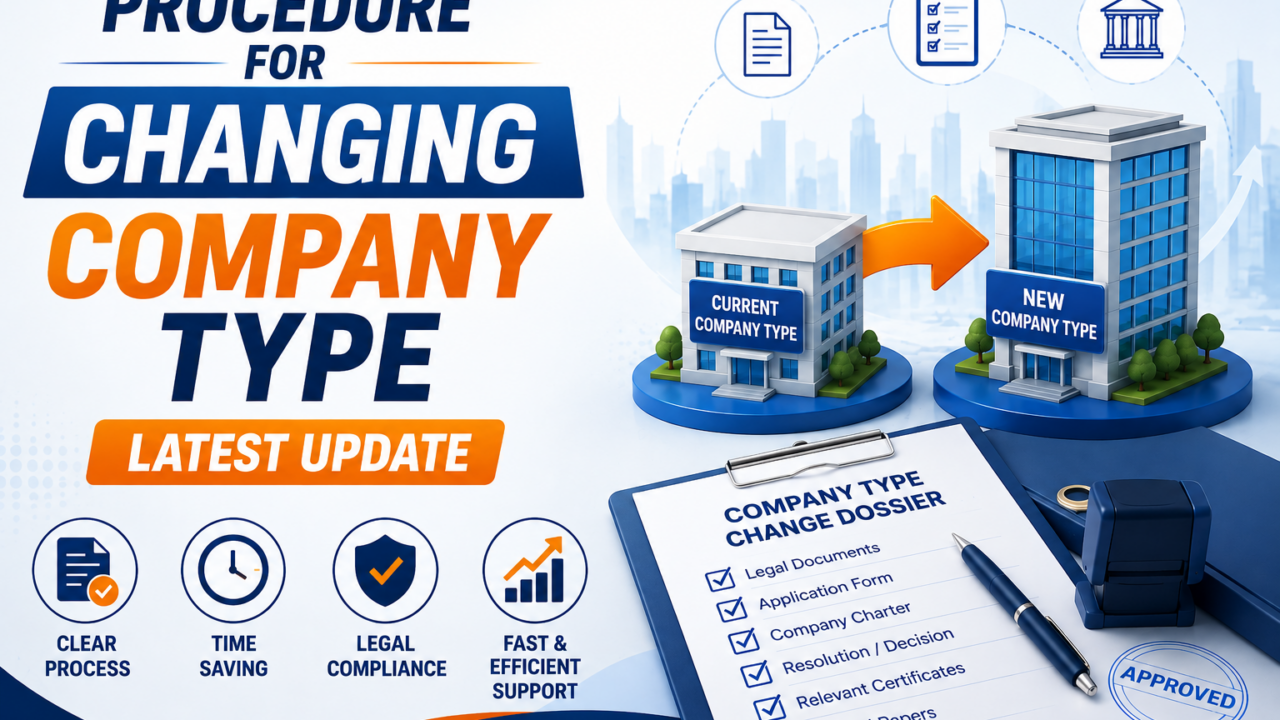
During business operations, growth in scale, strategic orientation, or fluctuations in shareholder structure often require enterprises to adopt a more fitting legal “coat.” At that point, carrying out the procedure to convert the enterprise type becomes an inevitable strategic move. However, this process is closely related to the Law on Enterprises, Tax Law, and the protection of stakeholders’ rights. The article below will provide you with the most comprehensive and updated guide for 2026 to ensure your restructuring process goes smoothly and safely.
1. What are the general regulations on enterprise type conversion?
1.1. What is the concept of enterprise type conversion?
Enterprise type conversion is a legal procedure aimed at reorganizing a business. Essentially, this is when an existing enterprise changes its legal form (e.g., from a Limited Liability Company to a Joint Stock Company) to suit its new scale and strategy, without having to undergo the procedures for dissolving the old enterprise and establishing a new one. This process allows the business to retain its tax code, operational history, and intellectual property assets.
1.2. Why do companies need to change their enterprise type?
Changing a company’s type brings immense benefits. When a Limited Liability Company (LLC) wants to raise capital from the public or prepare to list on the stock exchange, converting to a Joint Stock Company (JSC) model is mandatory. Conversely, a JSC with an overly cumbersome apparatus that wants to streamline for easier management and quicker decision-making can convert back to an LLC model. This conversion helps businesses increase operational efficiency, professionalize management, and thoroughly resolve legal bottlenecks.
1.3. The principle of inheriting rights and obligations after conversion
Note: A core principle under the 2020 Law on Enterprises is inheritance.
Upon successful conversion, the new enterprise (the converted company) naturally inherits all the lawful rights and interests of the old enterprise. At the same time, they must continue to be responsible for debts (including bank loans and partner debts), tax obligations to the state, maintaining current labor contracts, and all other property obligations of the company prior to the conversion.
1.4. Legal conditions to be allowed to change company type
Enterprises cannot arbitrarily convert but must fully meet the conditions prescribed by law. A prerequisite is that the company must meet all the criteria of the newly formed enterprise type (For example: Converting to a JSC requires a minimum of 03 shareholders; converting to a multi-member LLC means the number of members cannot exceed 50). Besides, the enterprise must have a legal decision from the Board of Members/General Meeting of Shareholders approving the conversion plan.
2. Popular forms of enterprise type conversion
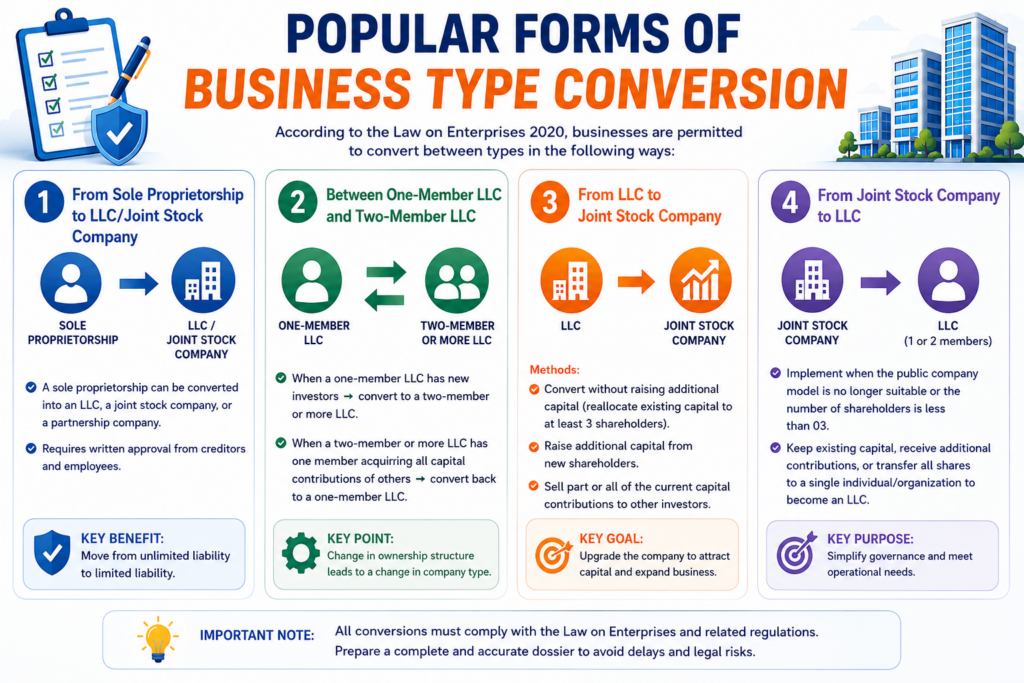
According to the provisions of the current Law on Enterprises, not all types can be cross-converted. Below are the forms of enterprise conversion permitted by law:
2.1. Conversion from a Private Enterprise to an LLC/JSC
Private Enterprises carry high risks (unlimited liability with all assets). The 2020 Law on Enterprises expanded rights, allowing Private Enterprises to be converted directly into an LLC, JSC, or Partnership if approved in writing by creditors and employees. This creates a safe exit for business owners wishing to switch to a limited liability regime.
2.2. Conversion between a Single-Member LLC and a Multi-Member LLC
When a single-member LLC acquires a new investor (because the owner sells a portion of capital or issues additional contributed capital), the company is forced to carry out the procedure to convert into an LLC with 2 or more members. Conversely, if a multi-member LLC has one member buy out the entire capital contribution of the others, the company must convert back to a single-member LLC model.
2.3. Procedures for converting an LLC to a JSC
This is the most popular upgrade path to attract capital. An LLC can convert into a JSC through the following methods: Conversion without raising additional capital (simply re-dividing the existing capital among at least 3 shareholders); Raising additional contributed capital from new shareholders; or Selling a part/all of the current contributed capital to other investors.
2.4. Procedures for converting a JSC back to an LLC
If the General Meeting of Shareholders finds that the public model is no longer suitable, or the number of shareholders drops below 03, a JSC can convert backward into an LLC (single-member or multi-member). The implementation method is similar: it can maintain the capital structure, receive additional capital, or transfer all shares to a single individual/organization to become a single-member LLC.
3. Detailed dossier and procedures for enterprise type conversion
3.1. Preparing the legal dossier according to current regulations
To proceed with the conversion procedure, the legal department needs to prepare a complete dossier as guided by Decree 01/2021/ND-CP. The dossier components include:
- Application for enterprise registration (using the form for the new type).
- Draft of the company’s Charter after conversion.
- Meeting minutes and Decision of the Board of Members/General Meeting of Shareholders regarding the conversion.
- Capital/share transfer contract or documents proving the gift/inheritance (if there is a change in members/shareholders).
- List of new Members/Shareholders accompanied by notarized copies of ID cards/Passports.
3.2. Sequence of submitting dossiers at the Business Registration Office
Currently, 100% of enterprise conversion dossiers are encouraged or required to be submitted online. The applicant will use a business registration account or a Digital Signature to upload PDF documents to the National Business Registration Portal. The place receiving and processing the dossier is the Business Registration Office under the Department of Planning and Investment of the province/city where the company is headquartered.
3.3. Appraisal time and issuance of the new Business License
After the system records a valid dossier, the statutory processing time is 03 working days. If the dossier has errors, the Business Registration Office will send a written notice requesting amendments or supplements. When the dossier is perfect, the state agency will revoke the old Certificate and issue a new Enterprise Registration Certificate recording the converted type, while retaining the original Tax Code.
3.4. Mandatory procedures after obtaining the new License (Taxes, Seals)
Having a new license is not the end. Due to the change in company type, the company name will change (For example: from X LLC to X JSC). Therefore, the enterprise is obligated to:
- Engrave a new legal entity seal.
- Notify the direct managing Tax authority to update legal entity information.
- Carry out procedures to destroy old invoices and register to use electronic invoices under the new company name.
- Update account information with the Bank and social insurance agencies.
4. Optimal solutions with enterprise type conversion services
4.1. Common risks when self-filing conversion dossiers
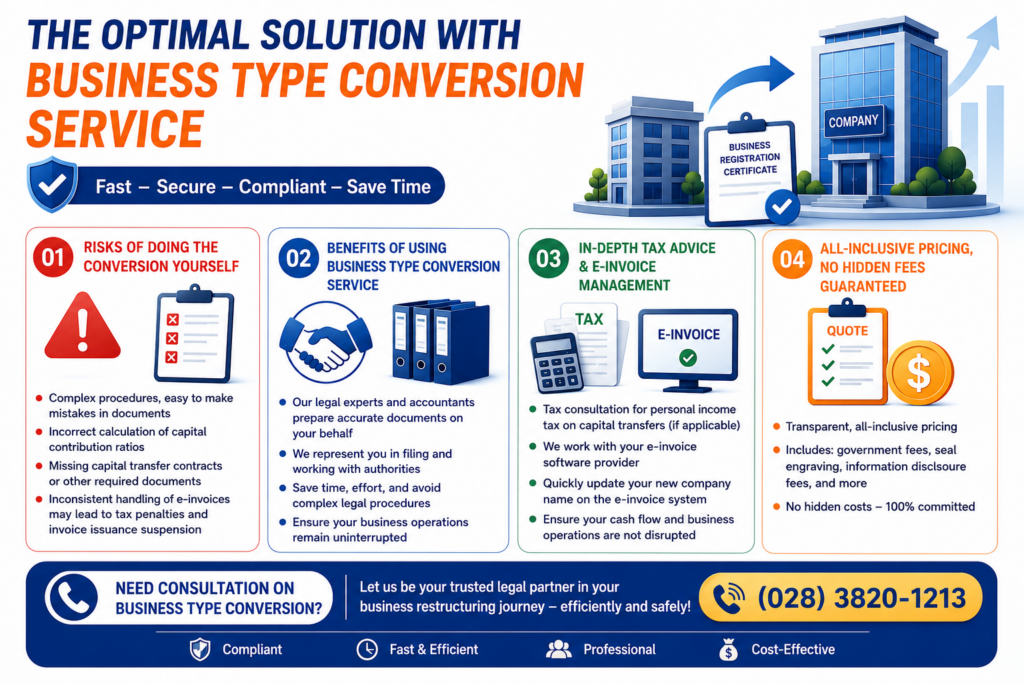
The procedure for converting an enterprise type is much more complex than a new establishment. If doing it themselves, businesses often make mistakes in drafting meeting minutes, miscalculating capital contribution ratios upon conversion, or failing to submit capital transfer contracts. In particular, handling unsynchronized electronic invoices after changing the company name can lead to tax penalties and frozen invoicing operations for days.
4.2. Benefits of using enterprise type conversion services
For the restructuring process to be swift and non-disruptive to business, using an enterprise conversion service is the optimal solution. A team of lawyers and accounting specialists will prepare the entire accurate dossier on behalf of the business, represent them in submitting it, and provide explanations to the authorities. You save dozens of hours traveling and worrying about cumbersome legal processes.
4.3. In-depth consulting on taxes and handling electronic invoices
The difference with a reputable service is the seamless accompaniment of legal and accounting aspects. We don’t just hand you a new license; we also support consulting on personal income tax declarations if the conversion process involves capital transfers. Additionally, an accounting specialist will help you work with the invoice software provider to update the new company name as quickly as possible, ensuring uninterrupted business cash flow.
4.4. All-inclusive quote, committing to no incurred costs
We provide enterprise conversion services with a transparent, all-inclusive quote. All expenses from state filing fees, seal engraving fees, to information disclosure fees are detailed in the contract, with an absolute commitment to no hidden costs. If you are facing a company restructuring decision and need a reliable legal companion, contact us immediately at (028) 3820-1213 for the most dedicated and effective consultation!
Converting an enterprise type is a landmark transformation, opening up new development opportunities for the organization. However, the complexity of legal regulations demands absolute caution in the dossier and post-inspection procedures. To eliminate all administrative risks and optimize time, choosing a professional legal service provider is the wisest decision for administrators. We are always ready to accompany your business on the path of sustainable and legal development.
If you have any questions, please contact our Hotline at (028) 3820 1213 or email us at [email protected] for prompt consultation and support. With an experienced team, Service thanhlap.wacontre.com is always ready to serve customers in the most enthusiastic and efficient manner. (For Japanese customers, please contact Hotline: (050) 5534 5505).