
Vietnam is currently an attractive destination for many international experts, investors, and workers. To live, work legally, and settle long-term here, completing the residency procedures is a particularly crucial legal step. The article below will provide a detailed guide on the latest updated regulations, application documents, and procedures for obtaining a temporary residence card for foreigners. Through this, we hope to help you grasp accurate information, save time and effort, and ensure full compliance with current laws.
1. What is a Temporary Residence Card for Foreigners?
1.1 Legal concept of a temporary residence card
A temporary residence card is essentially a type of long-term, fixed-duration visa. This legal document is issued to foreigners by the competent Immigration Authority of Vietnam. It serves as legal proof, granting a foreign national the right to reside for a specific period within the territory of Vietnam. By possessing this card, foreigners can securely live, work, or invest without worrying about repeatedly renewing short-term visas, thereby creating a solid foundation for their long-term plans in Vietnam.
1.2 Common types of temporary residence cards today
In practice, the Vietnamese government categorizes temporary residence cards based on each individual’s purpose of entry and stay. The most common categories currently include cards issued to foreign investors (symbol ĐT), cards for licensed workers (symbol LĐ), and cards for relatives of foreigners or Vietnamese citizens (symbol TT). Accurately identifying the type of card to apply for is an extremely critical first step in the entire legal service process, helping to avoid submitting under the wrong category, which could lead to the application file being returned or the license being denied.
1.3 Legal benefits of possessing a temporary residence card
Once holding a temporary residence card, foreigners will enjoy a series of practical benefits. Most notably is the right to exit and enter Vietnam multiple times throughout the card’s validity without having to reapply for a visa. Furthermore, cardholders can carry out other important civil procedures such as purchasing an apartment (for certain eligible groups), registering a marriage, conducting bank transactions easily, and even sponsoring relatives to visit or live with them in Vietnam.
1.4 Maximum validity of each type of temporary residence card
The law clearly stipulates the validity period for each type of card based on the target group. Specifically, for workers who have a work permit or fall under the work permit exemption category, the card’s validity is a minimum of 1 year and a maximum of 2 years. Meanwhile, special preferential policies apply to investors contributing capital to businesses in Vietnam, where the card’s validity can extend to a maximum of 5 to 10 years. This reflects the government’s efforts in attracting international investment capital.
2. Conditions for Granting a Temporary Residence Card to Foreigners
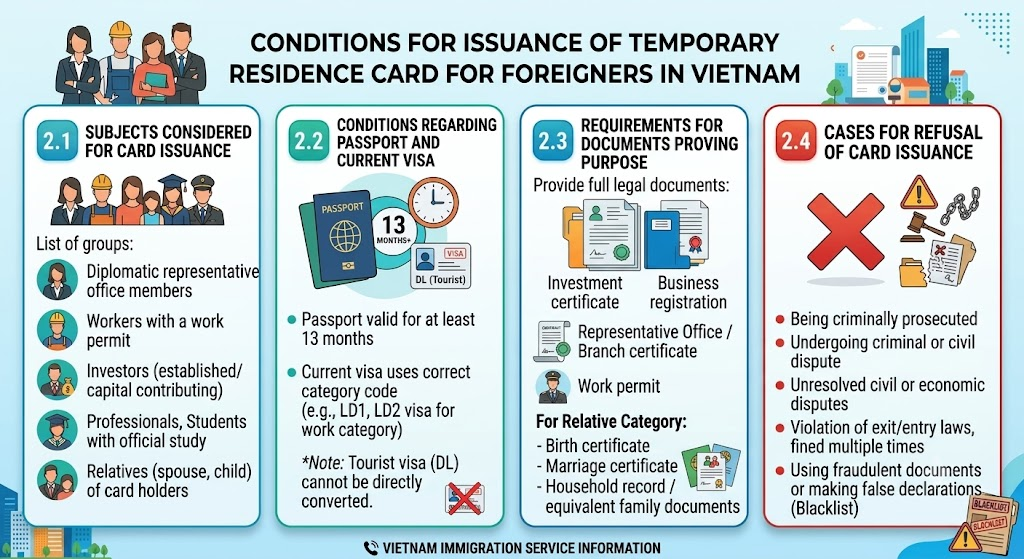
2.1 Subjects considered for card issuance
Not every foreigner entering Vietnam is automatically granted a temporary residence card. The law limits it to certain specific groups, including: members of diplomatic missions, foreigners granted work permits, investors who directly establish or contribute capital to an enterprise, experts, students coming to study in formal programs, and relatives (spouses, children) of those who have already been granted the card. Verifying whether one belongs to these groups is a prerequisite before proceeding to the next steps.
2.2 Conditions regarding current passports and visas
One of the technical barriers many people often overlook is the passport’s validity. To be considered, a foreigner’s passport must be valid for at least another 13 months. Concurrently, the visa currently being used in Vietnam must bear the symbol corresponding to the initial purpose of applying for the temporary residence card. For example, if you want to apply for a work-based card, your entry visa must mandatorily bear the symbol LĐ1 or LĐ2. If you entered on a tourist visa (DL), you cannot directly convert it to a temporary residence card but must proceed with exit procedures or change the purpose according to the law.
2.3 Requirements for documents proving the purpose
For functional agencies to have a basis for approval, applicants must provide complete legal documents proving their purpose of stay. Depending on the case, one of the following documents is required: Investment Certificate, Business Registration Certificate, License for Establishing a Representative Office or Company Branch, Certificate of Board of Management Membership, or Work Permit. Additionally, for the family visitation category, a Birth Certificate, Marriage Registration, or Family Register is mandatory if applying for a temporary residence card for a foreign Husband, Wife, or Child.
2.4 Cases of card denial
Even if all basic conditions are met, authorities still have the right to refuse to issue a temporary residence card to foreigners in certain special situations. Typical examples include individuals who are facing criminal prosecution, have unresolved civil or economic disputes in Vietnam, or have repeatedly been administratively penalized for immigration law violations. Using forged documents or declaring untruthful information during the application process is also a primary reason for denial and being blacklisted by the Immigration Department.
3. Documents for Applying for a Temporary Residence Card for Foreigners
3.1 Legal documents of the individual and sponsoring entity
A perfectly prepared application file is the key to a swift approval process. The required application file must include the Legal entity application file of the sponsoring agency, organization, or enterprise. A notarized copy of the enterprise registration certificate and the company’s seal sample are mandatory. On the foreign individual’s side, the most important document is the original Passport of the applicant. These documents aim to affirm the legality of the sponsoring entity and the identity of the sponsored person.
3.2 Prescribed application forms for the card
The system of forms plays a role in clearly expressing the will and commitments of the parties. Previously, regulations required the Request Document from the inviting/sponsoring agency, organization, or individual to be form N7A. However, according to the latest legal updates, this has been replaced by form NA6 (for agencies, organizations) and NA8 (individual declaration). The applicant needs to prepare the Declaration form for a new Temporary Residence Card with a 3cm x 4cm photo attached. The information filled in the declaration must absolutely match the passport and related documents.
3.3 Supporting documents for work and investment categories
For groups coming to Vietnam for work or business, the application file requires highly specialized documents. Specifically, you need to submit the original or a notarized copy of the Work Permit or Investment Certificate/Business Registration Certificate, depending on legal status. If working at foreign representative offices or branches, the License for Establishing a Representative Office or Company Branch must be supplemented. For senior management levels, a Certificate of Board of Management Membership must be provided.
3.4 Documents for family visitation and residency categories
Besides documents proving family relationships (marriage, birth certificates), an indispensable document to complete the residency procedure is confirmation from the local police. Foreigners must provide a Document proving temporary residence declaration or a Certificate of temporary residence in the locality, signed and stamped for confirmation by the police of the commune/ward where the person actually resides. The omission of this document is the most common error causing a application file to stall, as foreigners often subjectively entrust it entirely to landlords or apartment management boards without double-checking the voucher.
4. Procedure for Obtaining a Temporary Residence Card for Foreigners
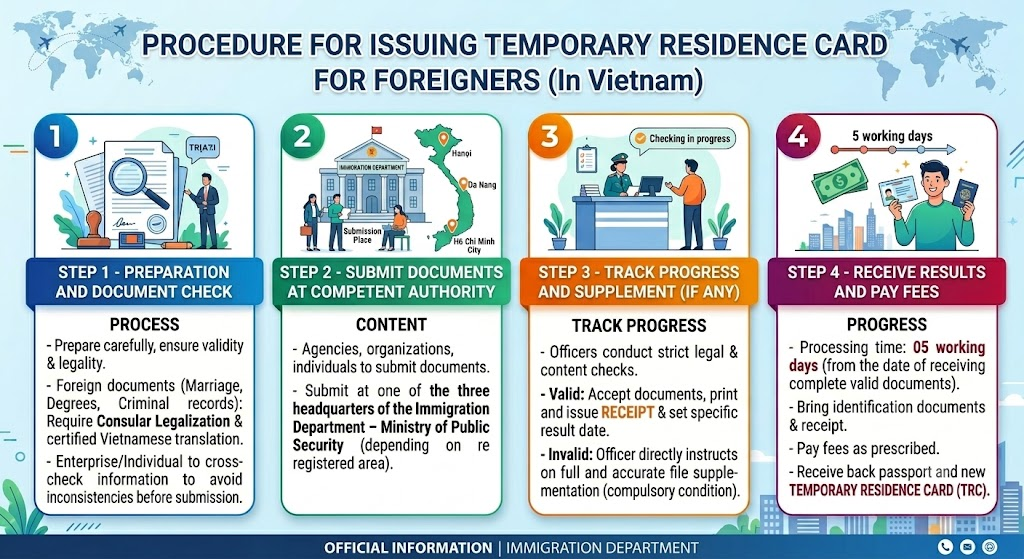
Step 1 – Prepare and check the application file
Step 1 of the procedure to obtain a temporary residence card is to prepare the application file thoroughly. This preparation goes beyond just collecting enough documents; it must also ensure the validity and legality of each paper. All documents issued abroad (such as marriage certificates, degrees, criminal records) must undergo consular legalization procedures, followed by notarized translation into Vietnamese. The sponsoring enterprise or individual should cross-check information to ensure no inconsistencies before submitting it to the state agency.
Step 2 – Submit the application file at the competent authority
Step 2 in the process is to submit the application file at the competent authority. Depending on the registered headquarters area of the sponsoring enterprise, the agency, organization, or individual submits the application file at one of the three main headquarters of the Immigration Department – Ministry of Public Security.
Step 3 – Track progress and supplement (if any)
At the functional agency, the receiving officer will inspect the legality and entire contents of your application file. This process is very rigorous. If the application file is complete and valid, the officer will receive it, print and hand over a receipt, and set a specific date for returning the results. Conversely, if the application file is invalid, the receiving officer will directly instruct the applicant to supplement the application file completely and accurately. Closely following these supplementary instructions is a mandatory condition for the application file to continue being processed.
Step 4 – Receive results and pay fees
The processing time for the temporary residence card procedure is relatively quick. Specifically, within 05 working days from the date the functional agency receives a complete and valid application file, the immigration management agency or the competent authority of the Ministry of Foreign Affairs will review and issue the temporary residence card. On the appointment date noted on the receipt, the representative brings their identification documents and the receipt to the submission place to pay the state-prescribed fee and receive back the passport along with the newly issued temporary residence card.
The process and procedures for applying for a long-term residence card require a profound understanding of the current legal system as well as absolute precision in document preparation. Above is all the detailed information about obtaining a temporary residence card in Vietnam, and this information will be frequently updated if there are new changes. Self-execution sometimes encounters hurdles due to language barriers and continuous changes in circulars and decrees.
If you have any questions, please contact our Hotline at (028) 3820 1213 or email us at [email protected] for prompt consultation and support. With an experienced team, Service thanhlap.wacontre.com is always ready to serve customers in the most enthusiastic and efficient manner. (For Japanese customers, please contact Hotline: (050) 5534 5505).